

Last year, a contractor in Arizona stood over a cracked foundation that ran the full length of a 60-foot slab. The concrete was four weeks old. The problem wasn’t the mix—it was the cement. He’d specified OPC in soil that tested at 2,000 ppm sulfates. Cases like this are more common than most builders want to admit. Choosing the right types of cement is the decision that determines whether a structure stands for decades—or fails within years.
The global cement industry produced roughly 4 billion metric tons in 2024. That staggering volume reflects a simple truth: nearly every structure on Earth depends on cement, and the wrong type leads to three predictable outcomes—premature cracking, sulfate attack, or thermal damage. All three are avoidable.
If you’ve ever felt overwhelmed by the sheer number of cement varieties on a supplier’s catalog, you’re not alone. Even experienced contractors sometimes default to Ordinary Portland Cement without considering whether the project demands something different. Below, you’ll find 15 cement types explained in plain language, the ASTM framework decoded, and a decision matrix you can actually use on the job site.
Key Takeaways
- ASTM C150 defines five Portland cement types (I–V), each engineered for specific environmental and structural conditions—from general-purpose to extreme sulfate resistance.
- Ordinary Portland Cement (OPC) suits most standard projects, but specialized conditions (marine exposure, mass concrete, freeze-thaw cycles) demand specialty cements like Type IV, Type V, or air-entraining variants.
- Portland Pozzolana Cement (PPC) offers superior long-term durability and chemical resistance compared to OPC, making it the better choice for marine, hydraulic, and sulfate-rich environments.
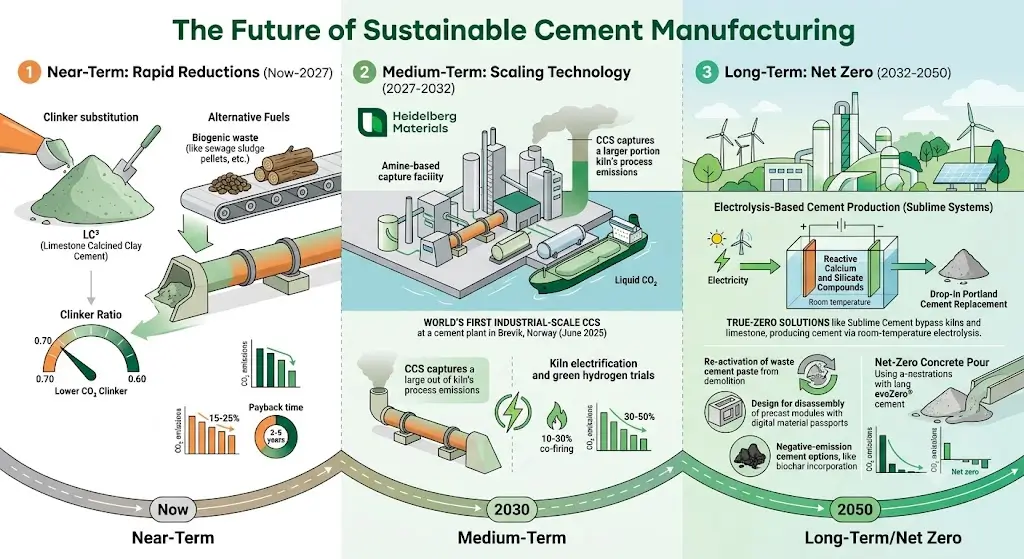
- The cement industry accounts for approximately 7–8% of global CO₂ emissions, but innovations like carbon capture (Heidelberg Materials’ Brevik facility) and geopolymer binders are reshaping sustainable construction.
- Choosing cement based on price alone is one of the five most common—and most costly—mistakes in construction; the right selection considers environment, structural demands, and curing requirements first.
Cement vs. Concrete: Understanding the Fundamental Difference
Before diving into the different types of cement, let’s clear up the most widespread misunderstanding in construction: cement and concrete are not the same thing. Mix them up on a purchase order, and you’ll get the wrong material delivered—worse, you might not realize it until the concrete fails.
What Is Cement? (Definition + Composition)
Cement is a fine binding powder; concrete is a composite material made from cement, water, sand, and gravel. When mixed with water, cement undergoes a chemical reaction called hydration to form a hardened matrix. It’s the glue—not the finished product. The most common type, Portland cement, is manufactured by heating a precise blend of raw materials to approximately 1,450°C in a kiln, producing what’s called clinker, which is then ground with a small amount of gypsum.
The chemical composition of Portland cement clinker is tightly controlled:
| Compound | Chemical Formula | Percentage Range |
|---|---|---|
| Calcium Oxide (Lime) | CaO | 59%–64% |
| Silicon Dioxide (Silica) | SiO₂ | 19%–24% |
| Aluminum Oxide (Alumina) | Al₂O₃ | 3%–6% |
| Iron Oxide | Fe₂O₃ | 1%–4% |
Technical Reference: These compounds combine during kiln firing to form four principal clinker minerals—C₃S (alite), C₂S (belite), C₃A (tricalcium aluminate), and C₄AF (tetracalcium aluminoferrite)—each responsible for different setting and strength characteristics.
Concrete, by contrast, is a composite material made from cement, water, fine aggregate (sand), and coarse aggregate (gravel or crushed stone). Cement typically constitutes only 10–15% of concrete’s total volume, yet it’s responsible for 100% of its binding action.
Why the Distinction Matters for Your Project
A contractor who orders “more cement” when they need stronger concrete ends up adding binder without adjusting the water ratio. The result? A weaker mix, not a stronger one. Cement is one ingredient. Getting the right ingredient starts with knowing which type you need. Understanding this distinction is the first step—our cement vs concrete deep dive → goes further into the chemistry and practical implications.
How Cement Is Classified: The ASTM Standard Framework
Not all cement is created equal, and the American Society for Testing and Materials (ASTM) provides the most widely recognized classification system for cement varieties used in North America and beyond.
ASTM C150 — Portland Cement Types (I, II, III, IV, V)
ASTM C150 is the primary standard for Portland cement types, defining five distinct varieties based on their chemical composition and intended performance:
- Type I (OPC): General-purpose cement for most construction where no special properties are required
- Type II: Moderate sulfate resistance and moderate heat of hydration
- Type III: High early strength for rapid formwork removal and cold-weather concreting
- Type IV: Low heat of hydration for mass concrete structures
- Type V: High sulfate resistance for severe sulfate exposure
Each type limits specific clinker compounds to achieve its performance profile. For instance, Type IV restricts C₃A to below 6% and increases C₂S to approximately 46% to minimize heat generation during curing.
ASTM C595 — Blended Hydraulic Cements
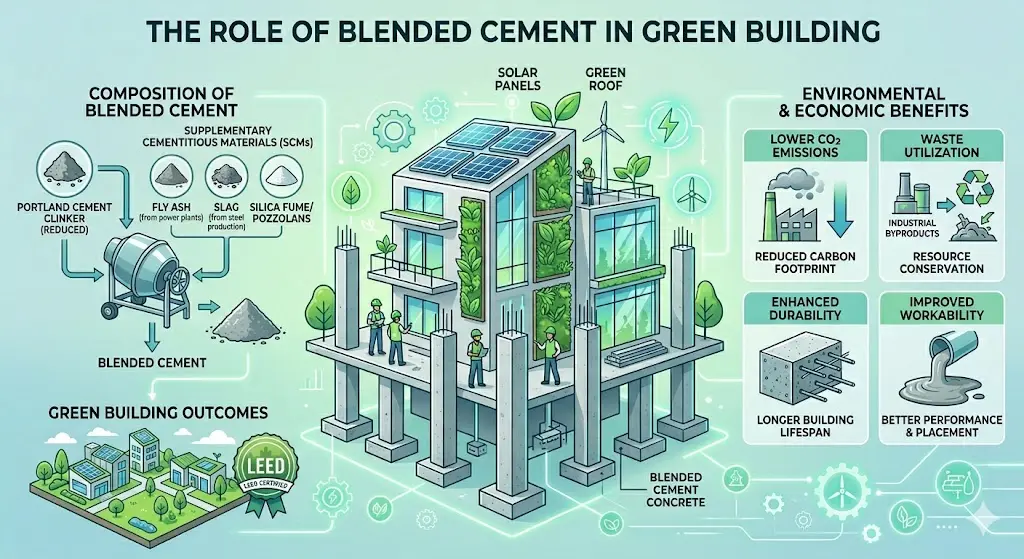
ASTM C595 covers blended hydraulic cements that combine Portland cement clinker with supplementary cementitious materials (SCMs) like fly ash, slag, or silica fume. Common designations include IS (Portland blast-furnace slag cement, widely used in marine and mass concrete for its low heat and chemical resistance), IP (Portland-pozzolan cement, the standard specification for PPC), and IL (Portland-limestone cement, now the dominant cement type in many markets due to its lower carbon footprint).
ASTM C1157 — Hydraulic Cement Performance Specification
Unlike C150 and C595, which prescribe chemical composition, ASTM C1157 takes a performance-based approach. It classifies cements by their actual performance in standardized tests rather than by their ingredients. This allows manufacturers to innovate with formulations while meeting the same performance benchmarks. The six types under C1157 include GU (general use, equivalent to Type I), MH (moderate heat), HE (high early strength), LH (low heat), MS (moderate sulfate resistance), and HS (high sulfate resistance, equivalent to Type V).
ASTM Classification Comparison Table
| ASTM Standard | Approach | Types/Categories | Key Differentiator |
|---|---|---|---|
| C150 | Prescriptive (chemical composition) | Type I, II, III, IV, V | Limits on clinker compounds |
| C595 | Prescriptive (blend proportions) | IS, IP, IL, IT | SCM type and percentage |
| C1157 | Performance-based | GU, MH, HE, LH, MS, HS | Meets performance tests regardless of composition |
Want a detailed breakdown of ASTM cement standards →? Or download our one-page cement comparison chart for job-site reference.
15 Types of Cement and Their Uses in Construction
This section covers the different types of cement you’ll encounter in construction, from the everyday to the highly specialized. Understanding each type’s unique properties helps you match the right material to your project’s demands.
1. Ordinary Portland Cement (OPC) — Type I
OPC is what most contractors reach for by default—and in many cases, that’s fine. But “default” and “correct” aren’t always the same thing. Ordinary Portland Cement accounts for the majority of cement used worldwide, delivering reliable strength development for general-purpose applications: residential buildings, pavements, bridges, and precast concrete where no special sulfate or heat conditions exist.
Best for: General construction, reinforced concrete structures, pavements Compressive strength at 28 days: 33–53 MPa (depending on grade)
2. Portland Pozzolana Cement (PPC)
Portland Pozzolana Cement blends Portland clinker with pozzolanic materials—fly ash, volcanic ash, or calcined clay. These additives react with a byproduct of cement hydration (calcium hydroxide) to form extra binding compounds—essentially getting more strength from the same amount of clinker. This secondary reaction, called the pozzolanic reaction, improves long-term strength and dramatically enhances chemical resistance.
Best for: Marine structures, hydraulic structures, mass concrete works, and environments with moderate sulfate exposure Advantage: Lower heat of hydration, improved workability, and greater resistance to alkali-aggregate reaction
3. Rapid Hardening Cement — Type III
Don’t confuse rapid hardening with quick setting—these are fundamentally different processes. Rapid hardening cement (Type III) achieves high strength at an early age because of its finer particle size and higher C₃S content. Its 3-day compressive strength equals OPC’s 7-day strength, allowing faster formwork removal and accelerated construction schedules.
Best for: Emergency repairs, cold-weather concreting, precast concrete manufacturing, and road repairs where traffic must resume quickly Caution: Generates more heat during hydration—avoid in mass concrete pours
4. Quick Setting Cement
While rapid hardening cement gains strength quickly, quick setting cement actually sets faster—it begins hardening within minutes rather than hours, achieved by reducing gypsum content and adding a small amount of aluminum sulfate. The initial set occurs in approximately 5 minutes, with the final set around 30 minutes.
Best for: Underwater concrete placement, grouting works, and emergency leak repairs Caution: Extremely short working time demands experienced placement crews
5. Low Heat Cement — Type IV
When massive concrete structures hydrate, the heat generated inside can reach dangerous levels—causing thermal cracking that undermines structural integrity. Low heat cement (Type IV) minimizes this risk by reducing C₃A content to below 6% and increasing C₂S to approximately 46%.
The most famous example of low heat cement in action? The Hoover Dam. In 1933, engineers faced a daunting problem: the 3.25 million cubic yards of concrete they needed to pour would generate so much internal heat that it could literally cook itself apart. Their solution was Type IV low heat Portland cement, combined with a network of cooling pipes embedded through the pour. The dam’s concrete continues to cool and gain strength to this day—nearly 90 years after construction began.
Best for: Mass concrete dams, large foundations, bridge piers, and any structure with cross-sections exceeding 1 meter Trade-off: Slower strength development; not suitable where early formwork removal is needed
6. Sulfate Resistant Cement — Type II/V
Sulfates in soil and groundwater attack concrete by reacting with cement’s hydration products, causing expansion, cracking, and eventual disintegration. Sulfate resistant cement limits the C₃A content—the compound most vulnerable to sulfate attack. Type II provides moderate sulfate resistance (C₃A ≤ 8%), while Type V delivers high sulfate resistance (C₃A ≤ 5%).
Best for: Foundations in sulfate-rich soils, wastewater treatment plants, coastal structures, and industrial environments
7–8. Blast Furnace Slag & High Alumina Cements
Blast furnace slag cement (ASTM C595 Type IS) replaces a significant portion of Portland clinker with granulated blast furnace slag—typically 25% to 65%—resulting in lower heat of hydration, improved chemical resistance, and reduced permeability. Best for mass concrete, marine structures, and projects prioritizing sustainability.
High alumina cement (calcium aluminate cement, CAC) is manufactured from bauxite and limestone, achieving exceptional early strength and performing at temperatures up to 1,600°C. Best for refractory linings and high-temperature applications. Warning: Susceptible to “conversion”—a structural transformation that can reduce long-term strength. Not recommended for structural concrete in normal construction.
9–15. Specialty Cements You Might Need
| Cement Type | Key Property | Best For | Key Note |
|---|---|---|---|
| White Portland | Brilliant white color | Architectural concrete, terrazzo | 3–4× the price of OPC |
| Colored | Pigmented throughout | Decorative paving, panels | Color permanence beats surface treatments |
| Air-Entraining (IA/IIA/IIIA) | Microscopic air voids (4–8%) | Freeze-thaw exposed structures | ~5% strength reduction vs non-AE |
| Expansive (K/M/S) | Counteracts drying shrinkage | Post-tensioning, grouting, pipe joints | Three subtypes for different expansion levels |
| Hydrophobic | Water-repellent coating | Long storage in humid climates | Oleic/stearic acid film during grinding |
| Masonry | Workable mortar formulation | Brick laying, stucco, plaster | Never use for structural concrete |
| Oil Well (API 10A) | High T/P resistance | Well cementing, geothermal | Grades A–H for different depths |
Comprehensive Comparison Table — 15 Types of Cement
| # | Cement Type | ASTM Type | Key Property | Primary Use | Heat of Hydration |
|---|---|---|---|---|---|
| 1 | Ordinary Portland (OPC) | C150 Type I | General versatility | General construction | Medium |
| 2 | Portland Pozzolana (PPC) | C595 Type IP | Chemical resistance | Marine/hydraulic works | Low–Medium |
| 3 | Rapid Hardening | C150 Type III | High early strength | Emergency repairs, precast | High |
| 4 | Quick Setting | — | Ultra-fast setting | Underwater/leak repair | Medium |
| 5 | Low Heat | C150 Type IV | Minimal heat | Mass concrete (dams) | Very Low |
| 6 | Sulfate Resistant | C150 Type II/V | Sulfate resistance | Foundations, wastewater | Low–Medium |
| 7 | Blast Furnace Slag | C595 Type IS | Durability + sustainability | Marine/mass concrete | Low |
| 8 | High Alumina | — | High-temp resistance | Refractory/industrial | High |
| 9 | White Portland | — | Aesthetic (white color) | Architectural concrete | Medium |
| 10 | Colored | — | Decorative (pigmented) | Decorative paving/panels | Medium |
| 11 | Air-Entraining | C150 Type IA/IIA/IIIA | Freeze-thaw resistance | Pavements in cold climates | Medium |
| 12 | Expansive | Types K/M/S | Shrinkage compensation | Grouting, post-tensioning | Medium |
| 13 | Hydrophobic | — | Moisture resistance | Humid storage/monsoon areas | Medium |
| 14 | Masonry | C91 | Workable mortar | Brick/block laying | Low |
| 15 | Oil Well | API 10A | High T/P resistance | Well cementing | Varies |
OPC vs PPC: Comparing Two Essential Types of Cement
Ask any ten contractors which cement to use, and at least seven will default to OPC. The other three will swear by PPC. They can’t both be right—or can they? These two types of cement account for the vast majority of cement used in construction globally, and understanding their differences is essential for making informed project decisions. For a deeper analysis, see our complete OPC vs PPC comparison guide →.
Composition Differences
OPC is composed entirely of Portland cement clinker ground with 3–5% gypsum. PPC, on the other hand, blends Portland clinker with 15–35% pozzolanic material (fly ash, volcanic ash, or calcined clay) plus gypsum. This pozzolanic addition fundamentally changes the hydration chemistry: instead of relying solely on the primary clinker reaction, PPC undergoes a secondary reaction where the pozzolan consumes calcium hydroxide (a byproduct of cement hydration) to form additional calcium silicate hydrate—the compound responsible for concrete strength.
Strength Development Timeline
- OPC: Reaches approximately 70% of its 28-day strength within 7 days. Ideal when early formwork removal is important.
- PPC: Gains strength more slowly initially, but continues gaining strength well beyond 28 days, often surpassing OPC’s strength at 90 days and beyond due to the ongoing pozzolanic reaction.
For time-sensitive projects where early strength is critical—precast manufacturing, rapid construction schedules—OPC has the advantage. For projects where long-term durability matters more than speed, PPC is superior.
Durability and Chemical Resistance
PPC’s pozzolanic reaction consumes calcium hydroxide—the most vulnerable compound in hydrated cement. The result is a denser, less permeable matrix that resists sulfate attack (less expansive ettringite forms), slows chloride penetration (protecting rebar), and reduces alkali-silica reaction risk. In plain terms: PPC-built structures last longer in hostile environments.
Cost Comparison
PPC typically costs 5–10% less per bag than OPC of equivalent grade—on a 500-cubic-yard pour, that can mean 2,000–5,000 in material savings alone. However, the slower strength development of PPC can sometimes offset this savings through longer formwork rental periods and extended construction timelines.
When to Use Which
| Condition | Choose OPC | Choose PPC |
|---|---|---|
| Fast-track construction needed | ✓ | |
| Precast concrete manufacturing | ✓ | |
| Marine or coastal environment | ✓ | |
| Mass concrete pours | ✓ | |
| High sulfate soil conditions | ✓ | |
| Budget-constrained project | ✓ | |
| Cold-weather concreting | ✓ | |
| Long-term durability priority | ✓ |
Still deciding between OPC and PPC? Start with a trial batch—mix both under identical conditions and test at 7, 28, and 90 days to see which performs better for your specific application. For more detailed analysis,
How to Choose the Right Types of Cement: A Decision Framework
Knowing the different types of cement is only half the battle. The other half is applying that knowledge systematically to your specific project. With so many cement options—each suited to different conditions—here’s a framework organized by the three factors that matter most.
By Project Type (Residential / Commercial / Infrastructure)
Residential Construction: For most homes, OPC (Type I) or PPC works well for structural elements. Masonry cement is appropriate for mortar, and air-entraining cement should be specified for exterior flatwork in freeze-thaw climates.
Commercial Construction: Office buildings, retail centers, and parking structures often demand higher-performance cements. Type II or PPC provides a margin of sulfate resistance for below-grade elements. Rapid hardening cement may be specified for precast façade panels requiring accelerated production.
Infrastructure: Bridges, dams, tunnels, and water treatment facilities face the most demanding conditions. Type V for sulfate exposure, Type IV for mass pours, air-entraining cement for bridge decks, and slag cement for marine structures—these aren’t options; they’re requirements.
By Environmental Conditions (Marine / Freeze-Thaw / High Sulfate Soil)
- Marine environments: PPC, blast furnace slag cement, or sulfate-resistant cement (Type V). The chloride and sulfate exposure demands both low permeability and chemical resistance.
- Freeze-thaw cycling: Air-entraining cement (Type IA/IIA/IIIA) is non-negotiable. Without entrained air, water freezing in concrete pores generates internal pressures that cause surface scaling and spalling.
- High sulfate soils: Type V for severe exposure, Type II for moderate conditions. Testing soil sulfate content before specification is essential.
Here’s what happens when you skip air entrainment in cold country: in December 2019, a contractor in Minnesota used standard OPC for an exterior commercial parking lot, assuming the project would be completed before the first hard freeze. A supply delay pushed the pour into late January, and the concrete was placed without air entrainment. By March, the surface had scaled so severely that the entire 12,000-square-foot lot required a polymer overlay—adding $85,000 to the project cost. The contractor now specifies air-entraining cement for all exterior work, regardless of the expected pour date. Lesson learned: in construction, assumptions about weather are expensive.
By Structural Requirements (High Early Strength / Low Heat / Water Resistance)
- High early strength: Type III (rapid hardening) when formwork turnaround is critical—precast plants, road repairs, cold-weather pours
- Low heat: Type IV for any pour deeper than 1 meter where thermal cracking is a risk
- Water resistance: Hydrophobic cement for storage; expansive cement for watertight joints; PPC for reduced permeability in hydraulic structures
Cement Selection Matrix
| Your Condition | Recommended Cement Type | Why |
|---|---|---|
| General residential construction | OPC Type I / PPC | Adequate strength, cost-effective |
| Coastal/marine structure | PPC / Slag cement / Type V | Chemical resistance, low permeability |
| Mass concrete (dams, thick foundations) | Type IV / PPC / Slag cement | Low heat, reduced thermal cracking |
| Freeze-thaw exposed structures | Air-entraining (Type IA/IIA) | Microscopic air voids prevent freeze damage |
| Emergency repair work | Rapid hardening (Type III) | Fast strength gain allows quick reopening |
| Sulfate-rich soil foundation | Type V / Type II | Resists sulfate attack on hydration products |
| Precast concrete manufacturing | Type III / OPC | High early strength for rapid formwork cycling |
| Decorative/architectural concrete | White cement / Colored cement | Aesthetic consistency, color permanence |
| Oil well cementing | API Class G/H | Engineered for extreme temperature and pressure |
Need a second opinion on your cement spec? A structural engineer can validate your choice in a single consultation
5 Common Mistakes When Choosing Types of Cement
We’ve watched experienced contractors make these five mistakes—and every one of them was expensive.
1. Confusing Cement with Concrete
We covered this earlier, but it bears repeating: ordering or specifying “concrete” when you mean “cement” (or vice versa) leads to incorrect material deliveries, mismatched specifications, and wasted time. Fix: Always use precise terminology in specifications and purchase orders. Cement is the binder; concrete is the composite.
2. Using OPC in Sulfate-Rich Environments
Standard OPC performs poorly in soils with high sulfate content—common in arid regions, areas with gypsum-bearing formations, and sites near industrial discharge. The sulfate attack can reduce concrete’s service life by decades. Fix: Always test soil and groundwater for sulfate content before specifying cement. If sulfates exceed 150 ppm, specify Type II; above 1,500 ppm, use Type V.
3. Ignoring Curing Requirements for Specialty Cements
Each cement type has specific curing requirements that directly affect its performance. Low heat cement needs extended curing periods. Rapid hardening cement demands immediate moisture control. Air-entrained concrete requires careful finishing techniques to avoid sealing the surface and trapping air. Fix: Include cement-specific curing procedures in your project specifications and verify compliance on-site.
4. Choosing Based on Price Alone
Spending 5,000moreontherightcementtodaybeatsspending85,000 on repairs in two years. Ask the Minnesota contractor from earlier. Using OPC in a marine environment might save 10% on material costs but halve the structure’s service life. Fix: Evaluate cement selection based on total lifecycle cost, including maintenance, repair, and expected service life—not just the unit price.
5. Overlooking Climate-Specific Requirements
Cement that performs beautifully in a temperate climate may fail catastrophically in extreme heat or cold. Hot weather accelerates setting, reducing workable time. Cold weather retards strength development, extending formwork periods. Freeze-thaw cycling destroys non-air-entrained concrete. Fix: Always factor local climate conditions into cement selection, including seasonal variations that might affect the construction schedule.
The Future of Cement: Sustainable and Green Alternatives
Here’s the uncomfortable truth about cement: making it produces about 7–8% of global CO₂ emissions—roughly 2.8 billion tons of carbon dioxide annually. As global demand continues to rise (driven by urbanization in developing economies), the industry must reconcile growth with climate responsibility. For sustainable cement alternatives transforming the industry →, see our dedicated guide. Several promising innovations are already changing the landscape.
Carbon Capture in Cement Production
Carbon capture and storage (CCS) represents the most mature pathway to decarbonize cement manufacturing. In June 2025, Heidelberg Materials officially inaugurated the Brevik CCS facility in Norway—the world’s first industrial-scale carbon capture installation at a cement plant. The facility is designed to capture approximately 400,000 tons of CO₂ annually, which will be permanently stored beneath the North Sea seabed. This single installation demonstrates that CCS at cement plants is not theoretical—it’s operational.
Geopolymer Cement and Alternative Binders
Geopolymer cement replaces Portland cement clinker entirely with aluminosilicate materials (such as fly ash or metakaolin) activated by alkaline solutions. These binders can reduce CO₂ emissions by up to 80% compared to conventional cement while delivering comparable—or even superior—performance in many applications.
Another approach: the ZeroCAL process, developed by researchers at the University of Colorado Boulder and the National Renewable Energy Laboratory, aims to eliminate the CO₂ emissions from limestone decomposition—the source of approximately 60% of cement’s carbon footprint. Early research suggests this electrochemical process could eliminate up to 98% of cement manufacturing CO₂ emissions, though commercial-scale implementation remains in development. According to the IEA’s 2025 Breakthrough Agenda Report on cement decarbonization, policy and investment momentum is accelerating these technologies toward commercial viability.
Blended Cements with SCMs (Fly Ash, Slag, Silica Fume)
The most immediately scalable approach to reducing cement’s carbon footprint is increasing the use of supplementary cementitious materials (SCMs). Blended cements that replace a portion of clinker with fly ash, ground granulated blast furnace slag, or silica fume offer:
- Lower embodied carbon (each ton of SCM replacing clinker avoids approximately 0.8–0.9 tons of CO₂)
- Improved durability through refined pore structure and reduced permeability
- Cost savings as SCMs are typically less expensive than clinker
Portland Limestone Cement (PLC) now accounts for approximately 75% of cement production in some markets, demonstrating how quickly the industry can shift toward more sustainable formulations when standards and market demand align.
Frequently Asked Questions
What are the different types of cement?
There are 15 primary types of cement used in construction: Ordinary Portland Cement (OPC), Portland Pozzolana Cement (PPC), Rapid Hardening Cement, Quick Setting Cement, Low Heat Cement, Sulfate Resistant Cement, Blast Furnace Slag Cement, High Alumina Cement, White Portland Cement, Colored Cement, Air-Entraining Cement, Expansive Cement, Hydrophobic Cement, Masonry Cement, and Oil Well Cement. These are further classified under ASTM standards C150, C595, and C1157.
How many types of cement are there?
The ASTM recognizes five Portland cement types under C150 (Type I through V), several blended cement types under C595, and six performance categories under C1157. Globally, including specialty cements not covered by ASTM, there are approximately 15 distinct cement varieties used in construction applications.
Which cement is best for house construction?
For most residential construction, OPC Grade 43 or 53 is suitable for structural elements like foundations, columns, and slabs. PPC is an excellent alternative that offers better long-term durability and chemical resistance, making it particularly suitable for foundations in areas with moderate sulfate exposure. For brickwork and plastering, use masonry cement rather than OPC.
What is the difference between OPC and PPC?
OPC (Ordinary Portland Cement) is pure clinker-based cement that achieves high early strength, making it ideal for fast-track construction. PPC (Portland Pozzolana Cement) contains 15–35% pozzolanic material, which reacts with calcium hydroxide to form additional strength-giving compounds. PPC gains strength more slowly but ultimately exceeds OPC’s long-term strength and offers superior chemical resistance, lower heat of hydration, and reduced permeability.
What type of cement is used for marine construction?
Marine construction demands cements with exceptional chemical resistance and low permeability. PPC, blast furnace slag cement, and sulfate-resistant cement (Type V) are the most commonly specified. The chloride and sulfate exposure in seawater attacks standard OPC, making these specialized cement varieties essential for durable marine structures.
Which cement is best for foundation?
The best cement for foundation depends on soil conditions. In normal soil, OPC Type I or PPC works well. In sulfate-rich soil (common in arid regions), Type II or Type V sulfate-resistant cement is essential. For foundations in coastal areas with both sulfate and chloride exposure, PPC or slag cement provides the best combination of chemical resistance and low permeability.
Conclusion: Making the Right Cement Choice
The right cement choice is rarely the most expensive one. It’s the one that matches your site, your structure, and your timeline. Three things to carry with you to the next project:
Match cement to environment. Sulfate-rich soils demand Type II or V; marine exposure calls for PPC or slag cement; freeze-thaw climates require air-entraining variants.
Match cement to structure. Mass concrete needs low heat (Type IV); fast-track projects benefit from rapid hardening (Type III); decorative work requires white or colored cement.
Test before you specify. Soil analysis, environmental exposure assessment, and trial mixes prevent costly specification errors. Start with your soil test results, match them to the selection matrix above, then specify with confidence.
Next time you’re at the supplier’s yard, take thirty seconds to match your conditions to the right cement type. Thirty seconds now, years of service life later.