

The world produces roughly 4.57 billion tons of cement every year — and a 1% quality deviation means 45 million tons of potentially defective material poured into bridges, buildings, and infrastructure. Cement quality control is the system that prevents that scenario from becoming reality. It spans every stage of production, from the chemistry of raw limestone to the compressive strength of the final 28-day cure test — and AI, real-time analytics, and Industry 4.0 automation are rewriting the rules, fast.
If you work in cement manufacturing, you already feel the weight of that responsibility. The margin for error is razor-thin, the regulatory landscape keeps tightening, and the cost of a bad batch — measured in recalls, lawsuits, and shattered reputations — can dwarf the cost of getting it right the first time. Three numbers to sit with: a 1% deviation means 45 million tons of risk, AI can push quality consistency above 95%, and blended cements now dominate 68.45% of global shipments. The rest of this guide explains what those numbers mean for your plant — and what to do about it. I’ll cover the testing methods that matter, the technologies changing the game, the standards you can’t ignore, and a phased roadmap you can actually implement.
Why Quality Control Matters in Cement Manufacturing
Structural Safety and Public Health Stakes
Concrete is the second most consumed material on Earth after water. Cement holds the built world together — literally. When cement fails to meet specification, the fallout doesn’t stay inside the plant. Under-strength concrete cracks under load. Excessive free lime causes unsoundness that manifests as delayed expansion, literally pushing structures apart from within. A mis-blended batch that slips through a weak quality assurance checkpoint can compromise an entire floor of a high-rise or a critical span of a highway overpass.
Consider what happened to a mid-sized Southeast Asian precast supplier in 2019. Their quality team noticed a subtle but persistent drop in 28-day compressive strength — roughly 4% below target — but attributed it to seasonal variation. By the time the root cause was traced to a limestone quarry seam with elevated MgO levels, three building projects had already incorporated the out-of-spec precast elements. The remediation cost: $12 million in structural reinforcement and a two-year project delay. The lesson: in cement quality control, “close enough” is never close enough.
The Cost of Quality Failures
So what does a bad batch actually cost? More than you’d think. A single rejected batch of cement — triggered by out-of-spec fineness, strength, or chemical composition — can cost upward of $50,000 in wasted raw materials, kiln fuel, and grinding energy. That figure doesn’t include downstream costs: customer claims, contract penalties, expedited re-testing, and the reputational damage that makes the next deal harder to close.
According to industry data, traditional paper-based quality record systems — still common in many plants — suffer data-entry error rates up to 15% (OxMaint, 2026). That means nearly one in seven data points used to certify product quality may be wrong. When an auditor asks for nine months of traceable certificates, a plant relying on filing cabinets and spreadsheets can spend weeks compiling the answer. One digitally transformed 3-million-ton-per-year plant reported cutting audit preparation time from two weeks to two hours after implementing a digital quality management system — a telling measure of the gap between old and new approaches.
Tired of two-week audit scrambles? [See how digital QC changes that →]
Regulatory and Compliance Imperatives
Cement isn’t just another industrial product — it’s a regulated construction material. Every major market enforces its own standards: ASTM C150 in the United States, EN 197-1 in Europe, IS 269/8112 in India, GB 175 in China. These standards define chemical limits, physical performance thresholds, and testing protocols that manufacturers must meet to legally sell their product. Non-compliance can result in product recalls, construction halts, regulatory fines, and criminal liability in extreme cases.
For plants that export across regions, the challenge compounds. A single product may need to satisfy ASTM C150 Type I, EN 197-1 CEM I 42.5N, and local standards simultaneously — each with slightly different limits on C3A content, MgO levels, or alkali equivalency. Multi-standard compliance isn’t optional; it’s the cost of doing business in a globalized market.
The Cement Quality Control Lifecycle: From Quarry to Delivery
Cement quality assurance doesn’t begin at the kiln and end at the silo. It starts with the geology of the limestone deposit and extends to the condition of the product when it reaches the customer. At every transfer point, variation creeps in. That’s also where you catch it.
Raw Material Testing and Validation
The quality of finished cement is largely determined before the raw meal even enters the kiln. Limestone, clay, sand, and iron ore each bring a specific chemical signature. The blend must hit precise targets for CaO, SiO₂, Al₂O₃, and Fe₂O₃ content. Quarry face mapping, drill-core analysis, and belt-cross-section sampling form the first line of defense. Modern plants use online PGNAA (Prompt Gamma Neutron Activation Analysis) cross-belt analyzers to measure elemental composition in real time, enabling continuous raw-meal proportioning adjustments rather than waiting for hourly lab results.
Clinker Quality Assurance (Free Lime, LSF, Burning Zone Control)
The burning zone is where chemistry becomes mineralogy. Key clinker quality indicators include:
- Free lime (f-CaO): Target below 1.5–2.0%. Excessive free lime signals under-burning and leads to unsoundness in the final cement.
- Lime Saturation Factor (LSF): Typically 92–98%. LSF governs the balance between alite (C₃S) and belite (C₂S) — the phases that determine early and late strength.
- Burning zone temperature and residence time: Directly affect clinker nodulization and phase formation.
Cement production quality management at this stage relies on kiln feed sampling every 1–2 hours, combined with periodic XRF analysis of clinker. Plants with online XRD systems can track phase composition (C₃S, C₂S, C₃A, C₄AF) in near-real time, closing the loop between kiln operation and clinker quality. For plants looking to improve clinker consistency, [kiln optimization strategies] can help align burning zone parameters with quality targets.
Finish Grinding and Fineness Control
Grinding is where clinker becomes cement. Particle size distribution directly impacts compressive strength development, water demand, and workability. The Blaine fineness test (ASTM C204) measures specific surface area, with typical targets of 300–400 m²/kg for ordinary Portland cement. But Blaine alone doesn’t tell the whole story — laser diffraction particle-size analysis provides a fuller picture of the distribution curve, helping optimize grinding circuit performance and gypsum addition rates.
Packaging, Storage, and Transport QC
Quality control in cement manufacturing doesn’t stop at the silo. Improper storage — exposure to moisture, carbonation, or contamination — can degrade cement before it reaches the customer. Quality checks at this stage include temperature monitoring in silos, bag weight verification, moisture content testing, and traceability labeling. For bulk deliveries, transport vehicle inspection and seal verification ensure the product that arrives on-site is the product that left the plant.
Core Laboratory Testing Methods
The laboratory is the backbone of any cement quality control program. These standardized tests form the evidentiary basis for product certification and regulatory compliance.
Compressive Strength Testing (2/7/28-Day Protocols)
Compressive strength is the single most important performance parameter for cement. Tested per ASTM C109 (mortar cubes) or EN 196-1 (prisms), it’s measured at 2, 7, and 28 days of curing. The 28-day result is the contractual specification point, but early (2-day and 7-day) results provide critical process feedback — a sudden drop in early strength often signals a raw-meal or kiln issue that would otherwise go undetected for weeks.
Setting Time and Soundness Tests
- Vicat setting time (ASTM C191): Initial set typically >45 minutes; final set <375 minutes for Type I cement. Controls workability window.
- Autoclave soundness (ASTM C151): Expansion limit 0.80% for most types. Detects delayed expansion caused by excessive free lime or periclase (MgO).
Chemical Composition Analysis (Bogue Calculation)
The Bogue calculation converts oxide composition (from XRF) into estimated phase composition — C₃S, C₂S, C₃A, and C₄AF. While Bogue values are approximations (they assume equilibrium conditions that don’t fully exist in industrial kilns), they remain the standard method for specifying and controlling cement chemistry. Typical Type I cement targets: C₃S 50–55%, C₂S 15–20%, C₃A 8–12%, C₄AF 6–10%.
Physical Properties (Blaine Fineness, Specific Gravity)
Beyond Blaine fineness (discussed above), other physical tests include specific gravity (typically 3.15 for OPC, per ASTM C188), residue on sieve (45 μm, per ASTM C430), and air content of mortar (ASTM C185). These properties influence mix design, water demand, and ultimate concrete performance.
Your testing workflow doesn’t have to look like 2015. [Start a free trial →]
Advanced Analytical Technologies Transforming QC
Lab testing is accurate — but by the time you see the results, the problem may be hours old. Advanced cement quality control technologies close the gap between detection and prevention, moving quality control from reactive to proactive.
X-Ray Fluorescence (XRF) — From Lab to Online
XRF is the workhorse of cement chemical analysis. Wavelength-dispersive XRF (WD-XRF) in the lab delivers precise oxide composition (CaO, SiO₂, Al₂O₃, Fe₂O₃, MgO, SO₃, Na₂O, K₂O) with typical accuracy of ±0.1–0.5% for major oxides. Energy-dispersive XRF (ED-XRF) instruments — smaller, faster, and more affordable — are increasingly deployed at-line for rapid screening.
The real shift, however, is the migration of XRF from the lab to the process line. Online XRF analyzers mounted on conveyor belts provide continuous elemental data, enabling real-time raw-meal correction. Plants that once adjusted mix proportions based on 2–4 hour lab turnaround can now respond in minutes.
X-Ray Diffraction (XRD) and Phase Analysis
While XRF tells you what elements are present, XRD tells you what compounds they’ve formed. This distinction is critical for clinker quality control. Free lime, for instance, shows up clearly in XRD patterns but is invisible to XRF (which only sees total CaO). Modern online XRD systems can track C₃S, C₂S, C₃A, C₄AF, free lime, and periclase in real time, giving operators a real-time window into clinker mineralogy they never had before.
FT-IR Spectroscopy for Raw Material Verification
Fourier-transform infrared spectroscopy (FT-IR) is gaining traction as a rapid, non-destructive tool for raw material verification. It can distinguish between different clay minerals (kaolinite vs. montmorillonite — critical for LC3 production), detect carbonate impurities, and assess the degree of calcination in supplementary materials. With measurement times under two minutes and minimal sample preparation, FT-IR bridges the speed gap between field inspection and full laboratory analysis.
Online Real-Time Analyzers (PGNAA/PFTNA)
PGNAA and its variant PFTNA (Pulsed Fast Thermal Neutron Activation) represent the gold standard for online bulk material analysis in cement plants. [PGNAA/PFTNA technology overview and applications] provide deeper technical details on how these systems work. Mounted across conveyor belts, they analyze the full depth of material flow — not just the surface — providing elemental composition data every 1–5 minutes. Key advantages include:
- No sample preparation: Measures material as it flows on the belt
- Full-volume analysis: Penetrates the entire burden, not just the surface layer
- Multi-element capability: Simultaneously measures Ca, Si, Al, Fe, S, K, Na, Mg, and more
- Continuous feedback: Enables closed-loop raw-meal and kiln-feed control
Comparison: Online vs. Offline Analysis — When to Use Which
| Parameter | Online (PGNAA/XRF) | Offline (Lab XRF/XRD) |
|---|---|---|
| Speed | 1–5 minutes | 1–4 hours |
| Accuracy | ±2–5% relative | ±0.1–0.5% relative |
| Sample prep | None | Fusion bead / pressed pellet |
| Best for | Process control, trend detection | Certification, regulatory compliance |
| Cost | High CapEx, low per-sample cost | Lower CapEx, higher per-sample cost |
| Coverage | Continuous, full stream | Discrete grab samples |
Don’t pick a side. You need online speed and offline precision — together. Online analyzers provide the speed needed for real-time process control; offline lab analysis provides the precision needed for product certification and compliance.
Automation and Industry 4.0 in Cement Quality Control
Something real is shifting in cement QC. Automation and AI are moving from demo decks to production floors, driven by measurable ROI and competitive pressure. Automated quality control systems in cement plants are no longer pilot projects — they’re production-scale deployments.
Automated Sampling and Monitoring Systems
Modern automated samplers extract representative material at defined intervals — from raw meal, kiln feed, clinker, and finished cement — without human intervention. Paired with pneumatic transport systems that deliver samples directly to the lab, they eliminate the sampling inconsistencies and delays of manual collection. Some systems integrate directly with at-line XRF or XRD instruments, creating a near-continuous analytical loop.
IoT Sensors and Real-Time Data Integration
The Internet of Things (IoT) is turning the cement plant into a living data ecosystem. Temperature sensors on kiln shells, vibration monitors on mill bearings, pressure transmitters on preheater stages, and flow meters on fuel lines — all feeding into a centralized data historian. For quality control, the breakthrough is the ability to correlate process parameters (kiln temperature profile, grinding circuit load, separator speed) with product quality outcomes in real time, rather than relying on post-hoc analysis.
AI and Machine Learning for Predictive Quality
[AI and machine learning in cement manufacturing] are delivering results that were impossible five years ago. The biggest gains? They’re coming from AI and machine learning:
- Predictive strength modeling: ML models trained on historical data (raw material chemistry, kiln conditions, grinding parameters, early strength tests) can predict 28-day compressive strength within hours of production — not weeks. One AI-driven system reduced cement strength variance by 62%, effectively eliminating quality-related batch rejections (OxMaint, 2026).
- Kiln optimization: AI controllers continuously adjust fuel rate, kiln speed, and ID-fan draft based on real-time clinker quality predictions, delivering 3–8% fuel savings and up to $2M/year in energy cost reduction.
- Predictive maintenance: Machine learning models detect equipment degradation before it affects product quality — one system flagged a kiln main-drive bearing anomaly 18 days before a potential catastrophic failure, avoiding an estimated $2.1M loss.
The numbers above aren’t theoretical. Here’s what happened when one plant put AI to work. In 2025, a mid-size European cement producer implemented an AI-based raw-material blending optimizer. The system continuously analyzed incoming limestone and clay composition via online PGNAA data and adjusted the raw-mill feed ratios in real time. Within three months, fuel consumption dropped 6.2%, translating to $1.8M in annual savings. More importantly, clinker free-lime variability fell by 40%, making the downstream quality control process significantly easier. The payback period: under eight months.
Digital Twins for Process Optimization
What if you could test a process change on your plant without risking a single ton of material? That’s what digital twins let you do. A digital twin mirrors the physical plant in real time — from raw meal to finished cement — allowing quality engineers to simulate “what-if” scenarios before committing to production changes. Want to know what happens to clinker LSF if you switch to a limestone seam with 2% higher MgO? The digital twin can tell you before you commit a single ton of material.
LIMS and Digital Quality Management Systems
Laboratory Information Management Systems (LIMS) are what ties it all together — sample tracking, test scheduling, out-of-spec alerting, and certificate generation, all in one system. When integrated with ERP systems and production databases, a LIMS provides full traceability from quarry to customer — the kind of traceability that turns a two-week audit scramble into a two-hour report. For plants ready to implement, this [LIMS implementation guide for cement labs] provides a step-by-step approach.
Curious what predictive quality looks like on your floor? [Try it free →]
International Standards You Can’t Ignore: ASTM C150, EN 197-1, and Beyond
Effective cement quality control requires understanding both ASTM and EN frameworks. These standards are the common language that ensures a bag of cement in Jakarta performs the same as one in Jacksonville. If you’re in QC, you live and breathe these specs — or you should.
ASTM C150 / C595 — American Standards Decoded
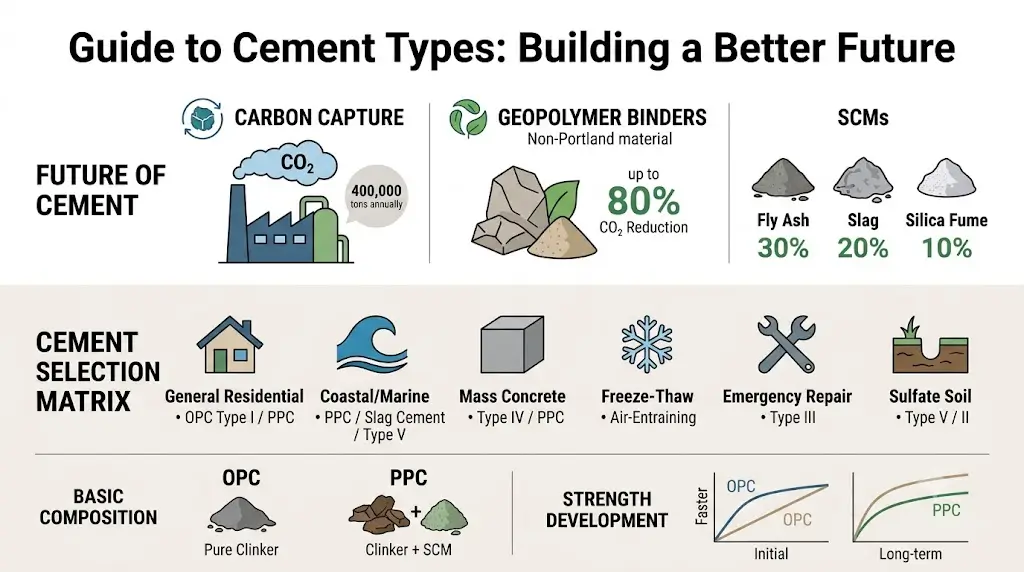
[ASTM C150/C150M standard specification] defines eight types of Portland cement (I, IA, II, IIA, III, IIIA, IV, V), each with specific chemical and physical requirements:
| Parameter | Type I (General) | Type II (Moderate Sulfate) | Type V (High Sulfate) |
|---|---|---|---|
| C₃S (%) | — | — | — |
| C₃A (%) | — | ≤8 | ≤5 |
| MgO (%) | ≤6.0 | ≤6.0 | ≤6.0 |
| SO₃ (%) | ≤3.0–4.5 | ≤3.0–4.5 | ≤2.3–3.0 |
| Autoclave expansion (%) | ≤0.80 | ≤0.80 | ≤0.80 |
ASTM C595 covers blended hydraulic cements (slag cement, pozzolan-modified Portland cement, etc.), with separate limits for each category. For a [comprehensive guide to ASTM cement standards], including full parameter tables and testing protocols, see our standards reference page.
EN 197-1 — European Cement Specifications
EN 197-1 defines 27 distinct common cement products across five main groups (CEM I through CEM V), with strength classes (32.5, 42.5, 52.5) and sub-classes (N for normal, R for rapid early strength). Key compliance requirements include:
- Minimum 28-day compressive strength per class (e.g., ≥42.5 MPa for CEM I 42.5N, with a maximum of 62.5 MPa)
- Chemical limits on chloride content (≤0.10% for reinforced concrete use)
- Sulfate content limits (≤3.5% as SO₃ for most CEM I products)
- Initial setting time minimums (≥60 minutes for 42.5 and 52.5 classes)
ISO 9001 and Quality Management Systems
ISO 9001 provides the overarching quality management framework within which specific cement standards operate. It requires documented procedures for process control, monitoring and measurement, nonconformity management, and continuous improvement. For cement plants, ISO 9001 certification is often a prerequisite for supplying to major infrastructure projects and government contracts.
Navigating Multi-Standard Compliance Globally
Plants that export to multiple regions face the complexity of satisfying overlapping — and sometimes conflicting — standards. A cement that meets EN 197-1 CEM I 42.5N might not satisfy ASTM C150 Type I due to differences in C₃A limits, alkali content caps, or physical test methods. Practical strategies include:
- Designing to the most restrictive standard across target markets
- Maintaining parallel test protocols (e.g., both ASTM C109 and EN 196-1 strength testing)
- Using digital compliance management tools that map requirements across standards automatically
Cement Quality Control Challenges for Low-Carbon and Blended Cements
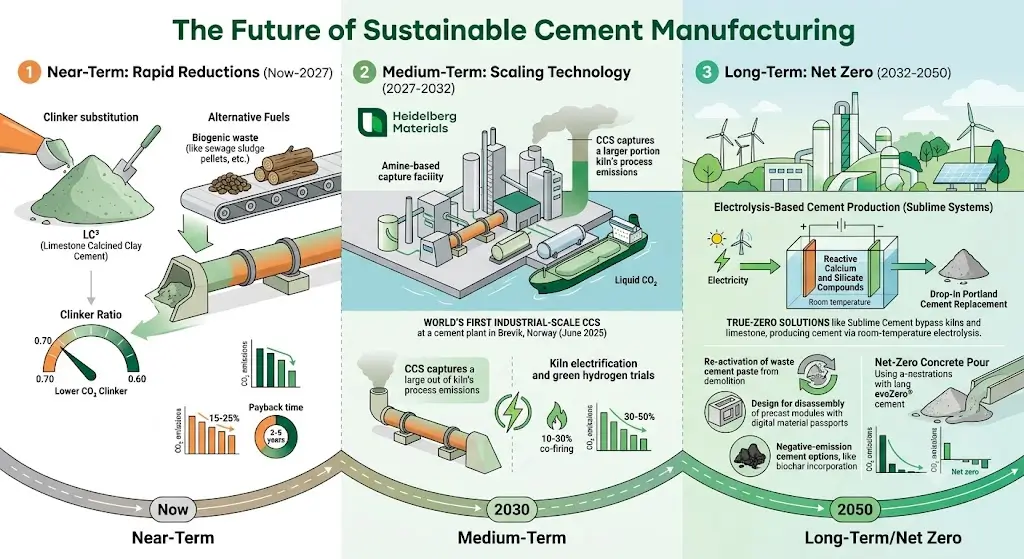
The cement industry’s decarbonization push is rewriting the QC playbook. Blended cements accounted for 68.45% of global cement shipments in 2025 (Mordor Intelligence, 2026), and the proportion is rising. For the full picture on [low-carbon cement technologies], including carbon capture and alternative fuels, see our sustainability guide. Cement quality control for blended products introduces new complexity that demands enhanced testing.
Calcined Clay and LC3 Quality Control
Limestone Calcined Clay Cement (LC3) can reduce CO₂ emissions by 30–40% compared to OPC, according to [recent peer-reviewed research on LC3 materials and performance], but its quality control introduces specific challenges. The kaolinite content of the raw clay must be precisely quantified (typically targeting >40% kaolinite) — too little and the pozzolanic reaction is insufficient; too much and the calcination energy requirement rises. FT-IR and XRD are essential for verifying both clay quality and the degree of dehydroxylation after calcination. Unlike clinker, where chemistry is tightly controlled by the burning process, clay sources can vary significantly within a single quarry, demanding more frequent and more granular testing.
Slag and Fly Ash Blending — New QC Demands
Ground granulated blast furnace slag (GGBFS) and fly ash are established supplementary cementitious materials (SCMs), but their quality is inherently variable because they’re industrial by-products, not manufactured products. Key QC parameters include:
- Slag: Glass content (>67% for Grade 100 per ASTM C989), fineness, and chemical consistency
- Fly ash: CaO content (determines Class C vs. Class F per ASTM C618), LOI (loss on ignition, typically ≤6%), fineness, and amorphous silica content
Cement manufacturing quality assurance for blended products must account for SCM variability with increased sampling frequency and tighter statistical process control limits.
Maintaining Consistency with Alternative Raw Materials
As the industry moves toward circular economy models — using construction demolition waste, steel slag, and other alternative raw materials — the chemical and physical variability of inputs increases dramatically. Real-time online cement quality monitoring systems become no longer optional — they’re survival tools, providing the continuous feedback loop needed to maintain product consistency when raw material inputs are inherently inconsistent.
Building a Modern QC Strategy: Implementation Roadmap
Transforming cement quality control from a paper-based, reactive function to a digitally enabled, predictive capability doesn’t happen overnight. The most successful implementations follow a phased approach that builds capability incrementally while delivering ROI at each stage.
Phase 1: Digital Checklists and Data Logging
Timeline: 1–3 months | Investment: Low | ROI: Immediate
The first step is eliminating paper. Digital checklists on tablets or mobile devices standardize data capture, enforce mandatory fields, and eliminate transcription errors. Coupled with a cloud-based LIMS, this phase delivers:
- 100% traceability of quality records
- Instant audit-readiness (recall the plant that cut audit prep from two weeks to two hours)
- Automatic out-of-spec alerting and escalation
- Baseline data collection for Phase 2 and 3 analytics
Phase 2: Online Analyzers and Equipment Integration
Timeline: 3–9 months | Investment: Medium-High | ROI: 6–12 months
This phase connects the physical process to the digital quality system. Installing online PGNAA or XRF analyzers on key process streams (raw meal, kiln feed, cement mill product) provides the real-time data needed for closed-loop control. Integration with existing DCS/SCADA systems creates a unified operational picture. Key outcomes include:
- Raw-meal correction lag reduced from hours to minutes
- Clinker variability reduced by 30–50%
- Grinding circuit optimization via continuous fineness feedback
Phase 3: AI-Driven Predictive Quality and Full Automation
Timeline: 9–18 months | Investment: High | ROI: 12–18 months (250%+ over 18 months)
With a foundation of clean digital data and real-time process analytics, AI and machine learning models can be trained to predict quality outcomes and prescribe optimal process adjustments. This phase delivers:
- Predictive 28-day strength from early process data
- AI-driven kiln and mill optimization (3–8% fuel savings, 95%+ quality consistency)
- Anomaly detection and root-cause analysis in minutes, not days
- Digital twin deployment for scenario planning
Key Performance Indicators (KPIs) for Cement QC
A modern QC strategy needs measurable KPIs to track progress and justify investment:
| KPI | Target | Measurement |
|---|---|---|
| 28-day strength variance (σ) | <1.5 MPa | Rolling 30-day standard deviation |
| Free lime in clinker | <1.5% average | Online XRD / hourly lab test |
| Out-of-spec batches | <0.5% | Monthly rejected / total produced |
| Audit preparation time | <4 hours | Time from request to report delivery |
| Data entry error rate | <0.5% | Automated validation checks |
| Raw-meal LSF deviation | ±2% of target | Online analyzer + lab confirmation |
Frequently Asked Questions
What is cement quality control?
Cement quality control is the system of testing, monitoring, and process management that ensures cement meets chemical, physical, and performance specifications from raw material extraction through delivery. It encompasses laboratory testing (compressive strength, XRF, XRD), online real-time analysis (PGNAA/PFTNA), and compliance with standards such as ASTM C150 and EN 197-1.
What are the main tests for cement quality control?
The main tests for cement quality control include compressive strength testing (2/7/28-day protocols per ASTM C109/EN 196-1), Vicat setting time (ASTM C191), autoclave soundness (ASTM C151), chemical composition analysis via XRF and Bogue calculation, Blaine fineness (ASTM C204), and specific gravity (ASTM C188).
How does AI improve cement quality control?
AI improves cement quality control through predictive strength modeling (reducing 28-day strength variance by up to 62%), real-time kiln optimization (3–8% fuel savings), predictive maintenance (detecting equipment failures before they affect quality), and automated raw-material blending optimization. AI-driven systems can predict 28-day compressive strength within hours instead of weeks.
What standards govern cement quality?
Cement quality is governed by ASTM C150 (American Portland cement standards with 8 cement types), EN 197-1 (European standards defining 27 common cement products across 5 groups), ASTM C595 (blended hydraulic cements), and ISO 9001 (quality management systems). Regional standards include IS 269/8112 (India) and GB 175 (China).
What is PGNAA in cement quality control?
PGNAA (Prompt Gamma Neutron Activation Analysis) is an online analyzer technology used in cement plants for real-time elemental composition measurement of bulk materials on conveyor belts. It provides continuous multi-element analysis (Ca, Si, Al, Fe, S, K, Na, Mg) every 1–5 minutes without sample preparation, enabling closed-loop raw-meal and kiln-feed control.
Conclusion
Cement QC used to be a back-office function. Not anymore. It’s the difference between a plant that survives and one that leads.
Quality failures cost far more than quality control — not linearly more, but catastrophically more. A single rejected batch runs $50,000+; a structural defect can cost millions. Real-time analytics and AI have closed the feedback loop: 62% variance reduction, 8% fuel savings, and predictive strength modeling that turns weeks of waiting into hours. And with blended cements now at 68.45% of global shipments, the old playbook doesn’t work anymore — continuous monitoring isn’t optional, it’s survival.