Rapid hardening cement is a specialized hydraulic binder that achieves compressive strengths of 25–30 MPa within just three days — roughly 50% higher than ordinary Portland cement over the same period — making it the material of choice when construction schedules refuse to wait. With global construction spending projected to reach 15.2trillionby2030andtherapidhardeningcementmarketclimbingfrom4.49 billion in 2024 toward $6.5 billion by 2035 at a 3.4% CAGR, the stakes have never been higher for engineers and project managers seeking faster, stronger, and more sustainable solutions.
If you’ve ever stared down a project timeline that demanded a road reopen by morning rush hour, or a bridge repair completed before the next freight train, you know the pressure. Time-critical construction doesn’t forgive delays — and ordinary cement doesn’t deliver speed. The good news? The science behind rapid hardening cement has entered a new era. From nano-modified formulations that accelerate early strength to calcium formate accelerators that replace corrosive chloride systems, and from 3D-printable blends to geopolymer binders that slash carbon emissions by up to 80%, the innovations landing in labs and on job sites right now are rewriting what’s possible.
In this article, you’ll discover five major breakthroughs transforming rapid hardening cement, explore real-world applications where these materials have saved projects from costly delays, understand the standards that govern their use, and get a clear view of where the market and the technology are headed next.
Key Takeaways
- Rapid hardening cement achieves 25–30 MPa at 3 days versus 16–20 MPa for OPC, driven by higher C3S content (50–60%) and finer particle sizing (>3,250 cm²/g).
- Five breakthrough innovations — R-UHPC, nano-modification, calcium formate accelerators, 3D-printable blends, and geopolymer binders — are expanding both the performance ceiling and sustainability of rapid hardening systems.
- Cemex’s Promptis/RapidSet technology enables road reopening in as little as 6 hours, while HeidelbergCement’s 2024 European high-speed rail contract signals large-scale infrastructure adoption.
- Geopolymer-based rapid hardening binders can reduce CO₂ emissions by 40–80% compared to Portland-based systems, addressing the cement industry’s carbon challenge head-on.
- The global rapid hardening cement market will grow from 4.49B(2024)to6.5B (2035), with APAC commanding the largest share and North America accelerating through infrastructure bill investments.
What Is Rapid Hardening Cement? (A Quick Technical Primer)
Before diving into what’s new, it’s worth establishing what makes rapid hardening cement — also referred to as high early strength cement or rapid hardening hydraulic cement — fundamentally different from the ordinary Portland cement (OPC) that dominates global construction.
Core Chemistry: Why C3S Makes the Difference
The performance gap starts at the molecular level. Cement clinker contains four primary compounds, and the proportions in rapid hardening cement are deliberately shifted toward faster-reacting phases:
| Compound | RHC Composition | OPC Composition | Role |
|---|---|---|---|
| C3S (Tricalcium Silicate) | 50–60% | 40–50% | Primary driver of early strength; hydrates rapidly |
| C2S (Dicalcium Silicate) | 15–25% | 25–35% | Contributes to long-term strength; hydrates slowly |
| C3A (Tricalcium Aluminate) | 7–10% | 8–12% | Controls initial set; generates early heat |
| C4AF (Tetracalcium Aluminoferrite) | 8–12% | 8–12% | Minor contributor to strength; affects color |
The elevated C3S content is the key. When water meets C3S, it triggers a rapid hydration reaction that produces calcium silicate hydrate (C-S-H) gel — the glue that binds concrete together. In RHC, this reaction is turbocharged: more C3S means more C-S-H forms in the first 24–72 hours, resulting in dramatically higher early strength.
Additionally, rapid hardening cement is ground significantly finer than OPC. A specific surface area exceeding 3,250 cm²/g (compared to ~2,250 cm²/g for typical OPC) increases the reactive surface available for hydration, further accelerating strength gain.
Key Performance Metrics at a Glance
The numbers tell the story most convincingly. Here’s how rapid hardening cement compares to ordinary Portland cement across critical curing periods:
| Curing Period | RHC Compressive Strength | OPC Compressive Strength | RHC Advantage |
|---|---|---|---|
| 1 Day | 16–20 MPa | 5–8 MPa | ~150–250% higher |
| 3 Days | 25–30 MPa | 16–20 MPa | ~50–65% higher |
| 7 Days | 35–40 MPa | 25–30 MPa | ~30–40% higher |
| 28 Days | 45–55 MPa | 40–50 MPa | Comparable |
Sources: IS 8041:1990; ASTM C1600/C1600M; typical manufacturer data sheets
Notice the pattern: the advantage diminishes over time. By 28 days, OPC catches up. This is by design — rapid hardening cement trades later-age strength parity for early-age urgency. The C2S that OPC relies on for long-term strength development eventually closes the gap, but for time-critical applications, those first few days are everything.
Curious how these numbers translate to real project timelines? The applications section below makes it concrete.
Rapid Hardening vs. Quick Setting: Not the Same Thing
This distinction trips up even experienced specifiers, and getting it wrong can derail a project. Rapid hardening and quick setting describe fundamentally different behaviors:
| Property | Rapid Hardening Cement | Quick Setting Cement |
|---|---|---|
| Mechanism | Accelerated strength development after setting | Accelerated initial setting time |
| Initial Set | Similar to OPC (~30–60 min) | Very fast (2–10 min) |
| Final Set | Similar to OPC (~3–5 hours) | Very fast (10–30 min) |
| Strength Development | Significantly faster than OPC at 1–3 days | Not necessarily higher than OPC |
| Typical Use | Roads, bridges, precast, cold weather | Leak sealing, anchoring, emergency plugging |
Quick setting cement (sometimes called fast setting cement) hardens fast but doesn’t necessarily get strong fast. It’s for when you need concrete to stop being liquid quickly — plugging a leak, anchoring a bolt, or sealing a tunnel ingress. Rapid hardening cement, by contrast, may set at a normal pace but gains structural strength at an accelerated rate — exactly what’s needed when a highway must reopen to traffic in six hours.
Confusing the two can mean specifying a material that stiffens before you finish placing it, or one that doesn’t reach load-bearing capacity in time. Neither mistake is cheap.
Understanding these fundamentals sets the stage for the innovations now pushing both the performance and sustainability of rapid hardening cement well beyond traditional limits.
5 Major Innovations Transforming Rapid Hardening Cement
The basic chemistry of rapid hardening cement hasn’t changed — C3S still drives early strength, and finer grinding still accelerates hydration. But what has changed is everything around that chemistry: new accelerator systems, nanoscale reinforcement, entirely new binder chemistries, and manufacturing methods that were unimaginable a decade ago. Here are the five breakthroughs reshaping the field.
1. Ultra-High Performance Rapid Hardening Concrete (R-UHPC)
In June 2025, a study published in Materials Letters demonstrated something that had long been considered a contradiction: a cement-based grout that achieves both rapid hardening and high fluidity — simultaneously. The research team used calcium formate as a primary accelerator in an ultra-high performance cement-based (UHPC) system, producing a material that flows like a self-compacting grout yet develops structural strength within hours.
Why does this matter? Traditional rapid hardening systems often sacrifice workability for speed. The faster a mix sets, the less time crews have to place and finish it. This trade-off has limited rapid hardening cement’s use in complex formwork, congested reinforcement, and intricate precast molds where flowability is non-negotiable.
R-UHPC dissolves that constraint. The calcium formate accelerator specifically promotes early C3S hydration without flash-setting the mix, preserving a workability window of 60–120 minutes while still delivering compressive strengths exceeding 40 MPa within 24 hours. For precast manufacturers, this means faster mold turnaround and the ability to cast complex geometries. For bridge deck repairs, it means a pumpable, self-leveling material that’s traffic-ready the next morning.
This dual achievement — speed without sacrifice — is arguably the single most impactful innovation in the rapid hardening space this decade.
2. Nano-Modified Rapid Hardening Cement
Nanotechnology is no longer a lab curiosity in cement science. Both nano-silica (nS) and nano-titanium dioxide (nT) have demonstrated measurable enhancements to early strength development in rapid hardening systems, and the research is accelerating.
Nano-silica works by providing an extraordinary number of nucleation sites for C-S-H gel formation. At dosages of 1–3% by weight of cement, nS particles fill nanoscale pores between cement grains and accelerate pozzolanic reactions, producing a denser microstructure and higher early compressive strength. A 2024 review in Applied Cement Science confirmed that nano-silica additions can boost 1-day compressive strength by 15–30% in rapid hardening formulations, depending on mix design and curing conditions.
Nano-titanium dioxide contributes through a different mechanism. Beyond its well-known photocatalytic properties (self-cleaning concrete surfaces), nT at optimal dosages of ≤4 wt% refines pore structure and promotes more complete hydration of C3S. A 2025 study published in Nature Scientific Reports documented substantial strength enhancements at both early and later curing ages with nT incorporation.
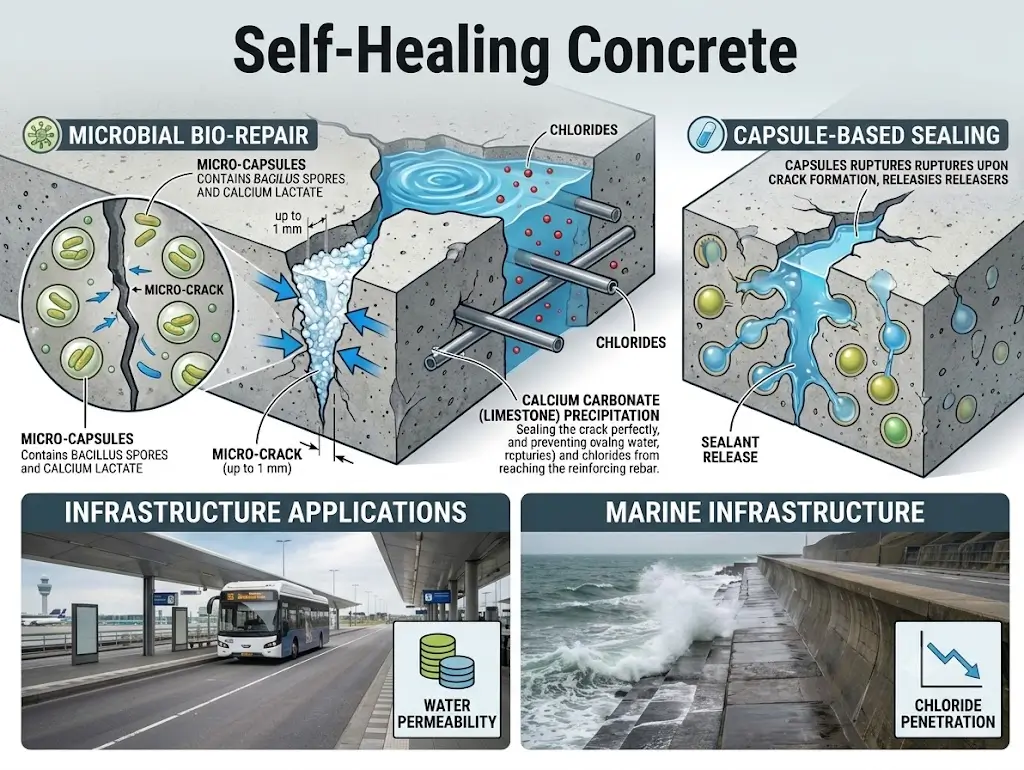
Perhaps most intriguingly, researchers are now exploring self-healing nano-modified rapid hardening concrete. The concept: embed nano-capsules containing crystalline admixtures or bacterial spores within the cement matrix. When microcracks form — whether from thermal stress, shrinkage, or loading — the capsules rupture, releasing agents that precipitate calcium carbonate and seal the cracks autonomously. In a rapid hardening system, where early-age thermal gradients can be more severe due to faster hydration heat release, this self-healing capability could be transformative for long-term durability.
Want to see how nano-modification could improve your next rapid repair specification? Explore the latest research on nano-enhanced cement systems to understand dosage optimization and compatibility with your existing mix designs.
3. Calcium Formate & Next-Generation Accelerators
The accelerator story in rapid hardening cement is one of evolution — and overdue correction.
For decades, calcium chloride (CaCl₂) was the dominant accelerating admixture. It’s cheap, effective, and well-understood. But it carries a fatal flaw: chloride ions corrode embedded steel reinforcement. In bridge decks, marine structures, and any reinforced concrete, CaCl₂-based accelerators can reduce service life by decades. Many specifications now explicitly prohibit chloride-based accelerators in reinforced concrete, and ASTM C1102 restricts their use.
Calcium formate (Ca(HCOO)₂) has emerged as the leading chloride-free alternative, and recent research confirms it’s not just a safer substitute — in some formulations, it’s a superior one. The 2025 Materials Letters study demonstrated that calcium formate effectively accelerates C3S hydration through a dual mechanism: it increases the concentration of calcium ions in solution (promoting faster C-S-H nucleation) and reacts with C3A to form calcium carboaluminate phases that contribute to early stiffening.
Beyond calcium formate, a new generation of accelerators is entering the market:
- Alkali-free accelerators (aluminum hydroxyl sulfate-based): Increasingly specified for sprayed concrete applications in tunneling, where alkali content must be minimized for worker safety.
- Organic-inorganic hybrid accelerators: Combining triethanolamine with inorganic salts to achieve both early set and sustained strength development.
- C-S-H seed accelerators: Pre-formed C-S-H nanoparticles that act as crystal growth seeds, bypassing the slow nucleation phase entirely. Research suggests these can reduce initial set time by 30–50% while maintaining or improving 28-day strength.
The shift from CaCl₂ to these next-generation systems isn’t just regulatory compliance — it’s a performance upgrade that extends service life and expands the range of applications for rapid hardening cement.
4. Rapid Hardening Cement for 3D Concrete Printing
3D concrete printing (3DCP) demands something that sounds simple but is technically demanding: a material that flows easily through a print head, then stiffens rapidly enough to support the weight of subsequent layers without deformation. This requirement — buildability — makes rapid hardening cement and 3D printing natural partners.
The challenge lies in timing. If the material stiffens too quickly, interlayer bonding suffers — cold joints form between layers, creating structural weak points. If it remains plastic too long, the structure collapses under its own weight. The ideal window is narrow, and rapid hardening cement’s accelerated hydration kinetics can be precisely tuned to hit it.
Recent research published in Construction and Building Materials (2025) identified six main strategies for enhancing interlayer bonding in 3D-printed concrete, several of which leverage rapid hardening chemistry:
- Controlled setting time adjustment using retarder-accelerator combinations
- Thermal activation of rapid hardening binders at the print nozzle
- Interlayer adhesive bonding with compatible rapid-setting mortars
- Modified print parameters (print speed, layer height) matched to material rheology
- Fiber reinforcement to bridge interlayer zones while maintaining printability
- Moisture management at the interlayer surface to prevent premature drying
The practical impact is already visible. Companies like COBOD and ICON are incorporating rapid-hardening binder systems into their large-format printers, and research groups at TU Eindhoven and ETH Zurich are pushing print speeds higher by optimizing the interplay between rapid hardening chemistry and robotic deposition rates.
For precast manufacturers and custom fabricators, 3D-printable rapid hardening cement opens a design space that traditional casting simply cannot reach — complex geometries, integrated channels, and functionally graded structures, all produced without formwork and at speeds that approach conventional construction timelines.
Ready to evaluate rapid hardening solutions for your printing or repair applications? Start with a free consultation to understand which accelerator system and binder type match your project’s specific time-to-strength requirements.
5. Low-Carbon & Geopolymer-Based Rapid Hardening Binders
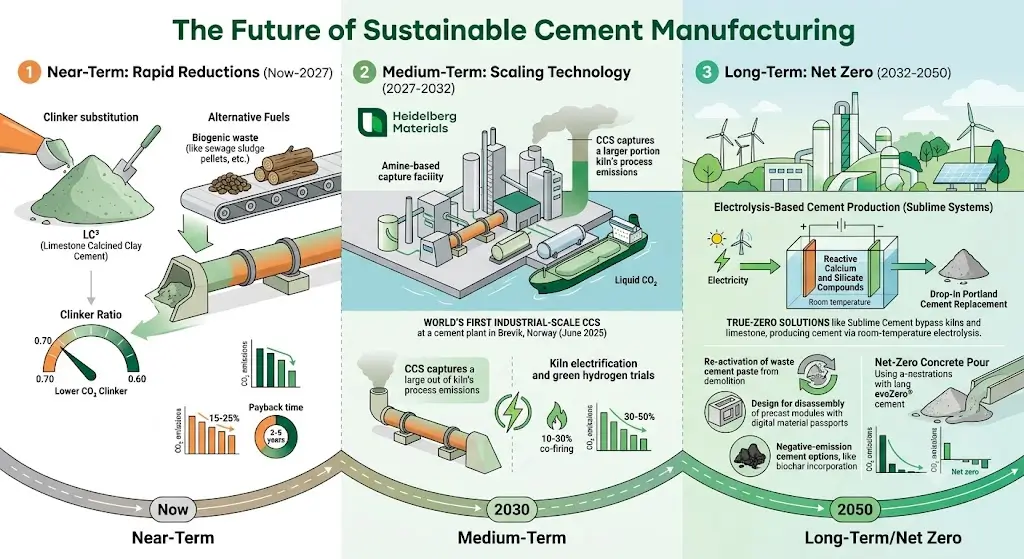
The cement industry accounts for approximately 8% of global CO₂ emissions. As carbon regulations tighten — the EU Emissions Trading System, the U.S. Inflation Reduction Act’s clean construction incentives, and China’s dual carbon goals all create pressure — the demand for lower-carbon alternatives to Portland-based cement has become urgent.
Geopolymer binders offer a compelling path. Made from industrial by-products like fly ash, ground granulated blast furnace slag (GGBFS), and metakaolin, geopolymers eliminate the clinker production step entirely — and with it, the process emissions that dominate cement’s carbon footprint. A 2025 review in Innovative Infrastructure Solutions confirmed that geopolymer concrete can achieve 40–80% reduction in CO₂ emissions compared to Portland cement concrete.
The catch? Traditional geopolymers are slow. Ambient-cured fly ash-based geopolymers may require 7–28 days to reach design strength — hardly “rapid” by any standard. But recent research is closing this gap:
- Alkali-activated slag systems with calcium formate: The same 2025 Materials Letters study on R-UHPC also demonstrated that calcium formate can effectively accelerate strength development in CaO-activated GGBFS systems, bringing geopolymer cure times closer to rapid hardening Portland cement.
- Thermally activated geopolymer rapid hardening: Controlled heat curing at 60–80°C can accelerate geopolymer strength development dramatically, achieving 30+ MPa within 24 hours — practical for precast operations where steam curing is already standard.
- Hybrid Portland-geopolymer systems: Blending Portland clinker with geopolymer precursors to achieve the early strength of C3S hydration with the lower carbon footprint of supplementary cementitious materials.
These aren’t theoretical possibilities. They’re active research programs with pilot-scale demonstrations underway in Europe, China, and Australia. For specifiers tracking both performance and embodied carbon, geopolymer-based rapid hardening binders represent the most significant long-term shift in the market.
The innovations above are compelling in the lab, but their real value emerges on job sites where time, budget, and safety converge. The next section brings them down to earth.
Real-World Applications in Time-Critical Projects
Rapid hardening cement earns its premium price tag in situations where delays cost more than materials. Here are the application areas where it delivers the most dramatic returns.
Emergency Infrastructure Repair
When a concrete highway develops a pothole that’s deep enough to damage vehicles, or a bridge deck loses a section of cover concrete, the question isn’t whether to repair — it’s how fast the repair can carry traffic.
This is where rapid hardening cement becomes indispensable. Cemex’s Promptis system, for example, allows roads to reopen to traffic in as little as 6 hours after placement. The system delivers compressive strength of ≥40 N/mm² within 24 hours and maintains a workability window of up to 120 minutes, giving crews adequate time to place and finish the material before it begins its rapid strength climb.
Consider a scenario that plays out weekly on Britain’s motorway network: an overnight lane closure for concrete repair. With OPC, the repair might need 7 days before it can carry full traffic loads. With a rapid hardening system like Promptis, the same repair can be completed and the lane reopened before the morning commute. The economic impact extends far beyond material costs — it includes avoided congestion penalties, reduced lane rental charges (which on major UK highways can exceed £10,000 per night), and minimized disruption to freight and commuter traffic.
Bridge emergency repairs follow the same logic but with even higher stakes. A bridge out of service can divert thousands of vehicles daily through alternate routes, increasing fuel costs, travel time, and accident risk. Rapid hardening cement enables same-day repairs that restore structural capacity within hours rather than days.
Cold Weather Concreting
Concrete placement in cold weather is a race against the clock. When ambient temperatures drop below 5°C, OPC hydration slows dramatically — and below 0°C, it can stop entirely. Traditional solutions involve heated enclosures, insulated blankets, steam curing, or simply waiting for spring. All are expensive; some are impractical.
Rapid hardening cement offers an elegant alternative: self-insulating hydration. Because RHC’s higher C3S content generates more heat during early hydration, the material effectively warms itself from within. The exothermic reaction peaks earlier and at a higher temperature than OPC, providing an internal heat source that counteracts cold ambient conditions.
Cemex’s Promptis system, for instance, is rated for placement at temperatures as low as +5°C — a threshold that covers much of the cold-weather construction season in temperate climates. For even colder conditions, combining rapid hardening cement with insulation blankets and heated mixing water can extend the workable window well into freezing temperatures.
In Scandinavia, Canada, and northern China, this capability has extended the construction season by weeks or even months each year, reducing the economic penalty of winter shutdowns.
Precast & Modular Construction
The economics of precast concrete hinge on mold turnaround time. Every hour a mold sits occupied is an hour it isn’t producing the next element. For a precast plant running 24/7, even a few hours saved per cycle compounds into significant annual output gains.
Rapid hardening cement allows demolding as early as 6–8 hours after casting, compared to 18–24 hours for typical OPC mixes. For a plant producing precast beams, that’s potentially two full production cycles per day per mold — doubling output without capital investment in additional molds.
The Cemex Promptis system explicitly targets this application, offering:
- Faster cycle times between pours
- Earlier demolding without compromising surface finish
- Consistent dimensional stability
- Compatibility with existing precast production equipment
For modular construction, where factory-produced units must meet tight production schedules to keep pace with on-site installation sequences, rapid hardening cement provides the production velocity the business model demands.
Marine & Hydraulic Structures
Marine environments are uniquely hostile to concrete. Chloride ingress, sulfate attack, alkali-silica reaction, and abrasion from waves and ice all accelerate deterioration. When marine structures — sea walls, breakwaters, jetties, tidal zones of bridges — need repair or construction, the working window is often dictated by the tide rather than the crew.
Sulfate-resistant rapid hardening cement (formulated with lower C3A content) addresses both the durability challenge and the time constraint. It achieves early strength for rapid commissioning while resisting the sulfate-rich seawater that would degrade standard OPC over time. In tidal repair work, rapid hardening cement must reach sufficient strength before the next tide cycle — often a window of just 4–6 hours.
The combination of rapid strength gain and enhanced chemical resistance makes these specialized formulations essential for coastal infrastructure, offshore platforms, and port facilities where downtime costs are measured in millions per day.
From roads to railways, bridges to breakwaters, rapid hardening cement has proven its value across applications. But specifying it correctly requires understanding the standards that govern its performance.
Standards, Specifications & Compliance
Specifying rapid hardening cement isn’t just about choosing the right product — it’s about ensuring that product meets the performance criteria your project demands. Several key standards define what “rapid hardening” actually means, and understanding their differences is essential for compliance and quality assurance.
ASTM C1600/C1600M — Performance Requirements
ASTM C1600/C1600M (most recently revised in 2025) is the primary U.S. standard for rapid hardening hydraulic cement. It’s a performance-based specification — meaning it defines what the cement must do, not how it must be made. There are no restrictions on composition or manufacturing process, as long as the finished product meets the specified physical requirements.
Key requirements include:
- Minimum compressive strength at specified ages (typically 1, 3, and 28 days)
- Setting time limits for initial and final set
- Soundness (autoclave expansion limits)
- Air content of mortar
The performance-based approach gives manufacturers flexibility to innovate — whether through accelerator chemistry, grinding fineness, or supplementary cementitious materials — while giving specifiers confidence that the product will deliver the early strength they need.
IS 8041 — Indian Standard for Rapid Hardening Portland Cement
India’s IS 8041 takes a more prescriptive approach. Originally published in 1990 and updated in 2026, it specifies chemical composition limits (including MgO content, sulfuric anhydride, and loss on ignition) alongside physical requirements. The standard explicitly notes that “the term ‘rapid hardening’ should not be confused with ‘quick-setting'” — underscoring how commonly these concepts are conflated.
Key IS 8041 requirements include:
- Minimum specific surface area of 3,250 cm²/g
- Compressive strength minimums at 1 and 3 days that exceed IS 269 (OPC) requirements
- Soundness limits per Le Chatelier and autoclave methods
- Chemical composition limits ensuring consistency and durability
For projects in India or those specifying to Indian standards, IS 8041 compliance is mandatory for any cement labeled “rapid hardening Portland cement.”
What Specifiers Need to Know
When specifying rapid hardening cement, keep these practical considerations in mind:
- Match the standard to the project location: ASTM C1600 for North American projects, IS 8041 for Indian projects, EN 197-1 for European projects (though Europe doesn’t have a dedicated rapid hardening cement standard — instead, CEM I 52.5 R or CEM I 42.5 R with high early strength designations are used).
- Specify performance, not just product names: Don’t just write “rapid hardening cement” on your spec sheet. State the minimum early compressive strength, maximum setting time, and any durability requirements (sulfate resistance, chloride limits) your project demands.
- Verify compatibility with admixtures: Rapid hardening cement’s accelerated chemistry can interact unpredictably with certain water reducers, superplasticizers, and air-entraining agents. Trial mixes are essential.
- Account for higher heat of hydration: The same chemistry that delivers early strength also generates more heat. In mass pours, this can cause thermal cracking if not managed through pour sequencing, cooling, or insulation.
Standards ensure quality, but the market determines who delivers it. The next section maps the competitive landscape.
Market Landscape & Industry Dynamics
The rapid hardening cement market is evolving rapidly, driven by infrastructure investment, sustainability mandates, and technological innovation. Here’s a clear picture of where the money and the momentum are flowing.
Global Market at a Glance
The numbers tell a story of steady, purposeful growth:
| Metric | Value |
|---|---|
| Market Size (2024) | $4.49 billion |
| Market Size (2025) | $4.64 billion |
| Projected Market Size (2035) | $6.5 billion |
| CAGR (2025–2035) | 3.4% |
Source: WiseGuy Reports, Rapid Hardening Cement Market Insights, 2025
Road construction dominates the application landscape, valued at 1.6billionin2024andprojectedtoreach2.2 billion by 2035. Bridge construction follows closely, with repair and maintenance applications growing as aging infrastructure demands rapid remediation.
Key Players & Recent Moves
Three recent industry moves signal the strategic importance of rapid hardening cement:
Anhui Conch × Mitsui (March 2025): China’s largest cement producer and Japan’s leading trading house announced a strategic partnership to jointly develop and commercialize rapid hardening cement technologies, including advanced admixture systems and high early strength formulations. The collaboration targets fast-growing infrastructure markets in China and Southeast Asia, where APAC infrastructure spending is projected to exceed $7 trillion in 2025 alone. For Anhui Conch, the partnership brings Mitsui’s chemical technology expertise; for Mitsui, it opens access to the world’s largest cement market.
Cemex RapidSet (July 2025): Cemex launched its new RapidSet rapid hardening cement product, designed to achieve early strength development within 6–8 hours. Building on the proven Promptis platform already established in the UK and European markets, RapidSet extends Cemex’s rapid-hardening portfolio into North American highway and infrastructure repair applications. The product targets a specific pain point: the enormous cost of lane closures and traffic disruption during concrete road and bridge repairs.
HeidelbergCement (November 2024): HeidelbergCement — now rebranded as Heidelberg Materials — secured a major multi-year framework agreement to supply rapid hardening cement for a European high-speed rail corridor. The contract validates RHC’s suitability for large-scale infrastructure where phased construction and rapid commissioning are essential. It also aligns with Heidelberg Materials’ broader strategy of offering specialized, higher-margin cement products rather than competing purely on commodity pricing.
Regional Growth Hotspots
Asia-Pacific (APAC) commands the largest market share, valued at 1.6billionin2024andprojectedtoreach2.3 billion by 2035. China and India are the primary engines, driven by massive infrastructure programs — India’s Bharatmala Pariyojana highway program and China’s continued investment in high-speed rail and urban transit systems.
North America is the fastest-growing market by percentage, propelled by the Infrastructure Investment and Jobs Act (IIJA), which allocated 550billioninnewfederalinfrastructurespending.Muchofthisspendingtargetshighwayandbridgerepair—exactlytheapplicationswhererapidhardeningcementdeliversthegreatestvalue.TheNorthAmericanmarketisprojectedtoreach1.45 billion by 2035.
Europe grows steadily, supported by the European Green Deal’s emphasis on sustainable construction materials and the continent’s extensive rail modernization programs. Stringent environmental regulations also drive adoption of lower-carbon rapid hardening alternatives.
Market dynamics shape availability and pricing, but selecting the right product for a specific project requires weighing advantages against limitations — which the next section addresses head-on.
Advantages, Limitations & Best Practices
No material is perfect for every application. Rapid hardening cement excels in specific scenarios but carries constraints that demand informed specification.
Proven Advantages
- Speed: The defining advantage. Reaching structural strength in hours instead of days compresses project timelines, reduces lane rental costs, and enables rapid return to service.
- Cold weather performance: Higher hydration heat extends the construction season in cold climates and reduces the need for external heating and insulation.
- Mold efficiency: In precast operations, faster demolding doubles or triples mold utilization rates, directly increasing plant output.
- Reduced traffic disruption: For road and bridge repairs, the economic value of faster reopening often dwarfs the material cost premium.
- Durability parity: At 28 days, well-designed RHC concrete achieves comparable strength and durability to OPC concrete — the speed advantage comes without long-term compromise.
Critical Limitations
- Higher cost: Rapid hardening cement typically commands a 20–40% price premium over OPC. This premium is easily justified in time-critical applications but wasteful when schedule pressure doesn’t exist.
- Higher heat of hydration: More heat means greater thermal gradients in mass pours, increasing the risk of thermal cracking. Mass concrete applications (>1 m section thickness) require careful thermal planning.
- Shelf life: The finer grinding that accelerates hydration also makes RHC more susceptible to moisture carbonation during storage. Open bags should be used within weeks, not months.
- Limited long-term data: While 28-day properties are well-characterized, decades-long performance data for newer formulations (nano-modified, geopolymer-based) is still accumulating.
- Admixture sensitivity: The accelerated chemistry can interact unpredictably with certain chemical admixtures, necessitating trial mixes for every new combination.
Best Practices for Specifying & Using RHC
- Justify the premium: Run a lifecycle cost analysis that includes traffic disruption savings, lane rental avoidance, mold utilization gains, and schedule compression benefits. The material premium almost always pays for itself in time-critical applications.
- Always trial mix: Don’t assume your standard admixture dosages will work. Test rapid hardening cement with your specific water reducer, air-entrainer, and any supplementary cementitious materials before committing to production pours.
- Manage thermal risk: For sections thicker than 500 mm, model predicted temperature rise and plan cooling or insulation strategies accordingly.
- Protect during storage: Store RHC in dry, enclosed conditions and use it promptly. Don’t stockpile it like OPC.
- Specify by performance: Write specifications around required early strength and setting time, not product names or composition. This gives contractors the flexibility to optimize mix designs while ensuring your performance requirements are met.
Knowing when to use rapid hardening cement — and when not to — is the mark of an informed specifier. The final section looks at where this technology is heading next.
The Future: Where Is Rapid Hardening Cement Heading?
The innovations covered in this article are not endpoints — they’re stepping stones toward a fundamentally more intelligent, sustainable, and responsive construction material system. Three trajectories stand out.
AI-Assisted Mix Optimization
Designing a rapid hardening cement mix involves balancing a dozen interdependent variables: cement type, accelerator type and dosage, water-to-cement ratio, supplementary cementitious materials, admixture combinations, and curing conditions. Traditional mix design relies on experience, iterative testing, and rules of thumb. Machine learning is changing that.
Researchers at several universities are training neural networks on thousands of experimental mix design results to predict compressive strength development curves for novel formulations. The goal: input your target early strength, workability window, and environmental conditions, and receive an optimized mix recipe in seconds rather than weeks of trial batches. Early results are promising, with prediction accuracies exceeding 90% for 1-day and 3-day strength forecasts.
For the industry, AI-assisted mix optimization could dramatically reduce the time and cost of developing application-specific rapid hardening formulations — particularly for 3D printing, where the parameter space is vast and the consequences of suboptimal mixes are expensive.
Self-Sensing Smart Rapid Hardening Concrete
What if your rapid hardening concrete could tell you when it’s reached target strength — without waiting for cylinder breaks? Self-sensing concrete embeds conductive materials (carbon fiber, graphene, or metallic particles) within the cement matrix, enabling real-time monitoring of strain, stress, and damage through changes in electrical resistance.
For rapid hardening applications, the most immediate value is strength monitoring. Since electrical resistivity correlates with hydration progress, embedded sensors could provide continuous, real-time data on compressive strength development — replacing the wait for lab-cured cylinder test results and enabling earlier, data-driven decisions about formwork removal, load application, and traffic reopening.
Cemex’s i-Con system already offers real-time concrete monitoring that pairs with the Promptis rapid hardening platform, representing an early commercial implementation of this concept.
Circular Economy-Driven Rapid Hardening Materials
The construction industry generates enormous volumes of waste concrete, and the cement industry consumes vast quantities of natural resources. Closing this loop — using recycled concrete as aggregate and recycled cement paste as a partial binder — is gaining traction as both environmental policy and economic strategy.
For rapid hardening cement specifically, the challenge is maintaining early strength performance while incorporating recycled content. Current research explores:
- Recycled cement paste thermally activated to recover clinker-like phases
- Recycled concrete fines as nucleation seeds that accelerate C3S hydration
- Industrial waste streams (steel slag, red mud, phosphogypsum) as alternative raw materials for rapid hardening clinker production
These approaches could simultaneously reduce the carbon footprint and raw material cost of rapid hardening cement — a compelling combination as carbon pricing mechanisms make their way into construction procurement worldwide.
Conclusion: Why Innovation Matters for Your Next Project
Rapid hardening cement has evolved far beyond “just faster OPC.” The five innovations explored in this article — R-UHPC with calcium formate acceleration, nano-modified formulations, next-generation chloride-free accelerators, 3D-printable blends, and low-carbon geopolymer binders — each address a specific limitation that has constrained the material’s adoption. Together, they expand the performance envelope, improve sustainability, and open new application frontiers.
The market data reinforces the trajectory: from 4.49billiontodayto6.5 billion by 2035, with APAC infrastructure spending alone exceeding $7 trillion this year. Industry leaders — Anhui Conch, Cemex, Heidelberg Materials — are investing strategically in rapid hardening products and partnerships. Standards bodies are updating specifications to accommodate new chemistries. And AI, self-sensing, and circular economy approaches promise to make the next generation of rapid hardening cement smarter, more transparent, and more sustainable.
The bottom line for your next project: if time is money — and in construction, it always is — rapid hardening cement deserves a seat at the specification table. Evaluate it not by its material cost premium, but by the schedule compression, traffic disruption savings, and production efficiency it unlocks.
[Explore rapid hardening cement solutions for your next project →] and discover how the latest innovations can compress your timeline without compromising performance. For ongoing insights on advanced construction materials and emerging technologies, subscribe to our technical newsletter and stay ahead of the curve.
The future of construction is faster than you think. Make sure your materials can keep up.