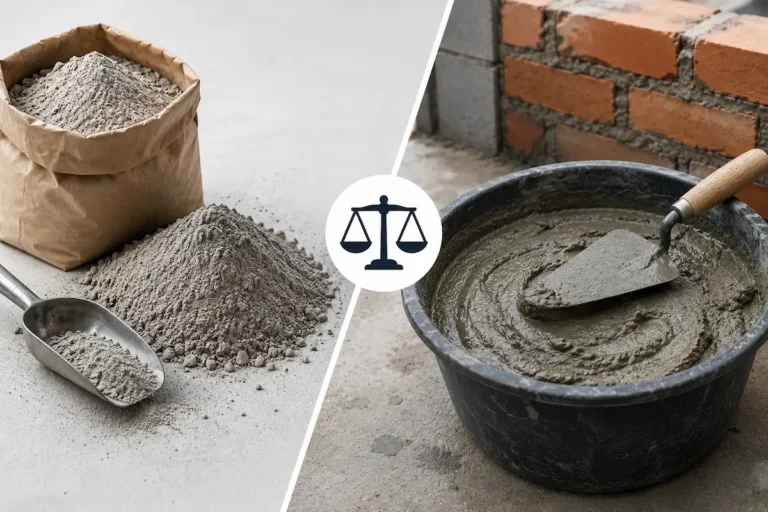


Anyone who’s specified flooring for a commercial project has run into the same problem at some point, where the finish material itself is fine but the subfloor underneath isn’t flat enough to take it. Self-leveling mortar is the product built to close that gap. It’s a cement-based underlayment poured across a floor, and instead of being spread by hand like a traditional screed, it flows and settles itself into a level surface.
This article covers what self-leveling mortar is made of, how the self-leveling effect actually works, where it gets used, and how thin-layer and thick-layer systems differ, so you can spec the right product before ordering.
What Is Self-Leveling Mortar?
Self-leveling mortar (sometimes called self-leveling compound, self-leveling underlayment, or self-levelling screed) is built from special cements, fine mineral fillers, and polymer additives. Mixed with water on site, it turns into a pourable, batter-like slurry rather than the stiff paste you’d get from ordinary mortar.
A standard sand-cement screed has to be pushed, raked, and troweled into place by hand, and getting it truly flat takes a skilled installer and a fair amount of time. Self-leveling mortar skips most of that labor. Once it’s poured, it spreads on its own, fills low spots, settles around high points, and leaves a substrate that’s ready for the next layer of flooring with little manual finishing required.
How Self-Leveling Mortar Works
The self-leveling behavior comes from the formulation itself rather than from any special pouring technique, and it usually comes down to three factors working together.
The cement and fillers are ground much finer than in a typical mortar. That reduces internal friction between particles, so the mix behaves more like a liquid than a paste. Polymer modifiers are added on top of that to improve flow, help bonding, and give the cured material some flexibility so it resists cracking. Flow agents round it out, keeping the mix workable long enough that it can actually level itself before it starts to set.
Once the mortar hits the floor, gravity takes over. It spreads outward, fills depressions, and settles flat, similar to how water finds its own level. Installers still typically use a gauge rake on larger pours, mostly to speed up coverage rather than to force the material flat.
Self-Leveling Mortar vs. Traditional Mortar or Screed
Traditional screed is stiff. It gets manually spread, compacted, and finished with a trowel, and a truly flat result depends heavily on the installer’s skill. Self-leveling mortar is formulated specifically to avoid that dependency. A good product should hold strong flowability well after mixing, in some cases 20 minutes or more, which gives installers a real working window to pour and finish a level surface without fighting the material.
The trade-off shows up in thickness. Screed can be built up thick in a single pass. Self-leveling mortar is usually sold in defined thickness bands instead, each tied to its own strength grade, so the product has to be matched to how much correction the floor actually needs.
Self-Leveling Mortar vs. Concrete
Both materials are cement-based, but they’re built for different jobs. Concrete is structural. It’s mixed with coarse aggregate and is designed to be strong and rigid once cured. Self-leveling mortar is a finishing and preparation material instead, and it swaps out the coarse aggregate for fine fillers and polymers, which lets it be poured thin, flow easily, and cure fast without cracking. You wouldn’t pour self-leveling compound to build a slab, and standard concrete isn’t going to give you a smooth enough base for vinyl tile either.
What Is Self-Leveling Compound Used For?
At its core, self-leveling mortar is an underlayment, a preparation layer that corrects unevenness before the finished floor covering goes down. A few applications come up constantly.
PVC and vinyl flooring is probably the most demanding case. Vinyl sheet flooring is thin and unforgiving, and any bump or dip in the subfloor telegraphs straight through it once it’s laid. Without a level underlayment underneath, it’s basically impossible to hide the imperfections.
Commercial and residential interiors are the bulk of everyday use. Homes, offices, gyms, and theaters all benefit from a fast, level base, and because it doesn’t need heavy machinery to install, it works about as well on a renovation as it does on new construction.
Hospitals and food workshops bring hygiene requirements into the picture. A formulation that’s casein-free, protein-free, and low in alkalinity gives a non-corrosive base that suits spaces which get cleaned constantly.
Warehouses face a different challenge, mostly constant foot and wheeled traffic wearing on the same surface day after day. A cosmetically flat pour won’t hold up there; what actually matters is real abrasion resistance and compressive strength.
Thin-Layer vs. Thick-Layer Self-Leveling Systems
Most self-leveling mortars are sold in two thickness categories, and which one you need depends on how far off level the existing substrate is.
Thin-layer systems cover roughly 6 to 10mm, rated in compressive grades from C16 up to C40 and flexural grades from F4 up to F10. These handle minor correction work before a finish coat goes down. Thick-layer systems go deeper, from about 10 to 30mm, with compressive grades from C25 to C40 and flexural grades from F6 to F10, and they’re meant for subfloors with more serious dips, damage, or height differences.
Getting this wrong costs you either way. Go too thin for the correction needed and the floor stays prone to cracking or wear. Go too thick and you end up paying for material and cure time the project never actually required.
How Self-Leveling Mortar Is Applied
The material does most of the leveling on its own, but a few steps still matter for a good result.
Start by cleaning the substrate. Oil, wax, curing agents, and grease all interfere with bonding and need to come off first. It’s also worth checking the floor’s flatness at this stage to work out how much thickness you actually need to pour. Mixing ratio matters too. A typical figure is around 1:0.15–0.17, powder to water, mixed until uniform. Temperature affects the cure as well, which is why most products call for application above 10°C. Once mixed, work fast: pot life is usually around 30 minutes, and once that window closes the material shouldn’t be reworked or thinned with more water. Don’t blend different self-leveling products together in the same pour either. It’s a reliable way to lose the performance you were counting on.
What to Look for in a Quality Self-Leveling Mortar
A few technical properties are worth checking on a data sheet before buying. Flowability that holds up over time matters more than the number right after mixing, because that’s what actually gives you a working window. Compressive and flexural strength should match the traffic the floor will see. For warehouse or industrial work, abrasion resistance is worth checking closely rather than assumed. Dimensional stability, meaning a low shrinkage or expansion rate, keeps the floor from cracking or lifting as it cures. Impact resistance testing, specifically whether the product shows any cracking or detachment under load, is also a decent proxy for how the floor will hold up in practice. Products that meet a recognized standard like GB/T 25181-2019 for ready-mixed mortar give you a benchmark you can actually compare across brands.
ChenSon FAVOR Self-Leveling Mortar
ChenSon’s FAVOR Self-Leveling Mortar is built around this exact profile. It’s a casein-free, protein-free, low-alkalinity cementitious underlayment for fine leveling ahead of PVC flooring, carpets, and other finishes, and it’s used in homes, hospitals, offices, gyms, theaters, and warehouses alike. It comes in both thin-layer (6–10mm, C16–C40/F4–F10) and thick-layer (10–30mm, C25–C40/F6–F10) grades, meets GB/T 25181-2019, and is suitable for manual application with a mixing ratio of roughly 1:0.15–0.17, powder to water.
If you’re preparing a floor for PVC flooring, carpet, or another finish and need an underlayment that stays flat, doesn’t crack, and holds up to real-world traffic, check the FAVOR Self-Leveling Mortar product page for full technical data and bulk quote information.
Frequently Asked Questions
What is self-leveling mortar used for? Mainly as a leveling underlayment poured over an existing subfloor to create a flat base before installing PVC flooring, carpet, tile, or other finishes. Homes, hospitals, offices, and warehouses are the most common settings, though the same logic applies anywhere a floor covering needs a genuinely flat surface underneath it.
How is self-leveling mortar different from regular mortar or screed? Regular mortar and screed are stiff and need manual spreading and troweling to get flat. Self-leveling mortar is formulated with finer particles, polymers, and flow agents so it spreads and levels itself under gravity instead.
Is self-leveling mortar the same as self-leveling concrete? Not exactly, though they’re often used interchangeably in casual conversation. Both are cement-based and flow to a level finish, but self-leveling mortar uses fine fillers rather than coarse aggregate, which is what lets it go down thin and cure quickly. If you’re comparing actual spec sheets rather than marketing copy, check the aggregate size before assuming the two products are the same.
What’s the difference between thin-layer and thick-layer self-leveling systems? Thin-layer covers roughly 6–10mm and suits minor subfloor corrections. Thick-layer runs deeper, roughly 10–30mm, for floors with more significant unevenness or damage.
Can self-leveling mortar be applied by hand, or does it need special equipment? Most residential and mid-size commercial jobs are done by hand. What matters is the product’s flowability window, ideally 20 minutes or more after mixing, since that’s what gives an installer time to pour and finish without rushing. Large industrial floors sometimes use pumping equipment simply for speed, not because the material requires it.
Is self-leveling mortar suitable for hospitals or food-grade environments? Yes, provided the formulation is casein-free, protein-free, and low-alkalinity. Those three properties are what make it non-corrosive enough for spaces that get cleaned constantly and can’t tolerate materials that break down or harbor bacteria over time.
How long does self-leveling mortar take to set before it can be walked on or covered? It depends on the product and how thick it’s poured, but most self-leveling mortars have a pot life of around 30 minutes after mixing and set up fast once they’re down. For exact cure and recoat times, always check the specific product’s technical data sheet rather than assuming one number applies across brands.