

Mortar occupies an oddly neglected position in construction. Procurement teams will battle their steel suppliers for weeks, grinding out savings down to fractions of a percent. Brick dealers get squeezed mercilessly. But mortar? It gets ordered in bulk based on somebody’s rough ballpark estimate and then completely forgotten until the job is done.
That’s when reality hits. You look at the final numbers and discover that 10% to 15% of your total masonry spend has simply evaporated—not into the walls where it was supposed to go, but into batches mixed too late in the afternoon, rain-soaked pallets that nobody protected, expensive emergency deliveries called in on Friday at 4 PM, and material specifications that are overbuilt for what your structural engineer needs.
So, Where Does It All Disappear?
Half of your mortar liability is tied up in the bags themselves. The other half—material handling, equipment costs, freight, labor, everything else—that’s where costs balloon and creep upward without anyone really paying attention.
Crews dump perfectly good material when the workday ends. You’ve seen this happen. It’s 3:30 in the afternoon, the masonry crew knocks off at 4:15, and there’s still a full batch of mortar sitting in the mixer. What happens to it? Straight into the dumpster. The American Concrete Institute documents that sloppy mixing practices like this can kill up to 15% of the batch yield. On actual job sites, it’s often worse. I tracked one project where the mixer operator would fill a batch late in the afternoon, the crew would ignore it, and somewhere between $400 and $600 worth of material would hit the waste bin every single week.
Over-specifying mortar is endemic. Walk through most job sites, and you’ll see Type S and Type M stacked up everywhere without much reason at all. Type S shows up on interior non-load-bearing walls. Type M gets used on straightforward above-grade veneer work where it’s completely unnecessary. Type N—which is cheaper and works perfectly well for non-load-bearing applications—somehow gets treated like a second-rate option.
Do the math: if 40% of your walls don’t require Type S or Type M, and you’re overpaying by $1.50 to $3.00 per bag for zero structural benefit, you’re hemorrhaging thousands per project just because of habit and inertia.
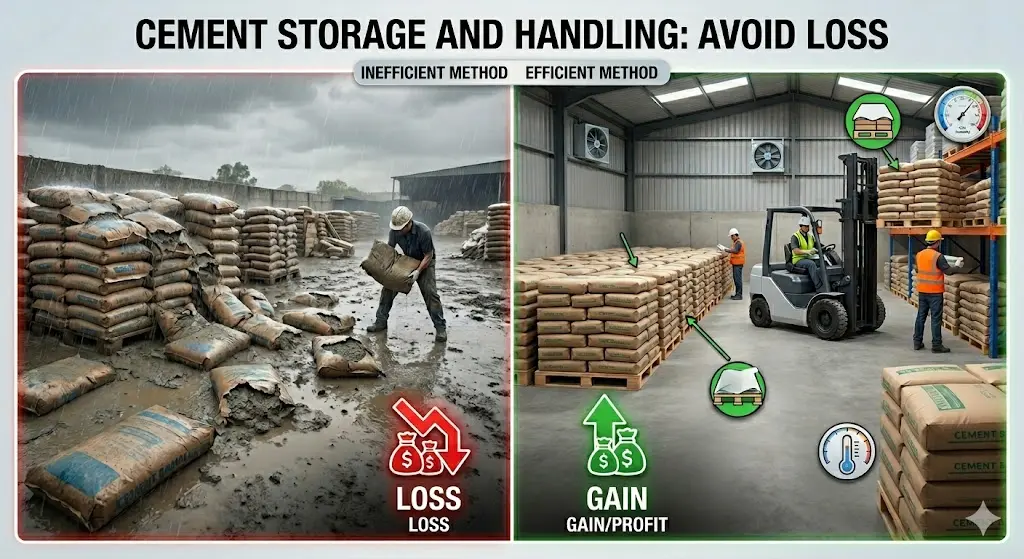
Field waste creeps higher than anyone wants to admit. Estimators routinely build a 5% to 10% waste buffer into their bids as defensive protection. But audit real job sites, and the numbers tell a different story. Pallets sitting in mud absorb groundwater and harden before they’re ever used. Bags tear open, and nobody catches it until a corner of the material has already set solid. Rain ruins an uncovered sand pile. Temperature swings mess with stored cement, bringing in moisture problems. By the time the job is actually finished, you’re looking at 12% to 14% waste, not 8%.
Take a standard $50,000 mortar budget at 8% to 10% waste—you’re throwing away $4,000 to $5,000. That’s not a rounding error. That’s actual money that should be holding the brick together.
Here’s What Real Changes Look Like
Instead of generic cost-cutting attempts, here’s what creates sustainable savings:
First, audit your spending systematically. Pull invoices from three of your completed projects. Line up every bag type and quantity against what the structural drawings specified. You’ll find that you ordered mortar stronger than your engineer required. It happens because field crews default to whatever worked on the last job, or because nobody spent 30 minutes drilling into the specifications. Once you spot the pattern, right-size your orders on the next project.
Next, work closely with engineers during pre-construction. Don’t let your field supervisors default to the strongest option just because it simplifies material management. Sit down with the structural team before the project kicks off and explicitly map out which walls need Type S and which can safely use Type N. Color-code your staging areas if you have to, to prevent accidental mixing. Make sure every foreman gets a clear schedule showing exactly which mortar type goes where. This upfront friction prevents chaos on the actual job site.
Your vendor base needs consolidation. If you’re buying mortar project-by-project from three different local suppliers based on convenience, you have zero leverage with any of them. What works is aggregating your realistic 12-month volume across all your jobs and presenting that number to one or two core distributors. They get predictable manufacturing runs or distribution schedules; you get a fixed per-bag discount that applies to every project, no matter the size. Include a clawback clause if volume drops, but lock in the savings upfront.
Instead of rigid Just-In-Time delivery, use a rolling supply buffer. JIT works beautifully on a spreadsheet. In reality, delivery trucks get stuck in traffic, rain shuts down work, and crews finish walls faster than anyone predicted. If you’re completely dependent on material arriving Friday morning and it shows up Monday afternoon instead, your masonry crew sits idle—and idle labor costs way more than having a few extra bags of dry mix sitting on-site.
Better approach: keep a rolling 3-day buffer of material on-site. Every Thursday afternoon, take a real look at what got placed that week and adjust next week’s delivery schedule accordingly. This avoids last-minute scrambling and expensive emergency freight charges without building up massive inventory overstock.
Digital takeoff tools beat rule-of-thumb ordering. The old “X bags per 1,000 brick” calculation is how you end up with 20% to 30% more material than you place. If you’re running BIM or using digital takeoff software, calculate exact joint volumes based on your specific block dimensions and wall areas. This shrinks your estimation error to 2% to 3%—no dead inventory lingering at the end, and no hassle hauling away surplus material you already paid for.
Three Approaches—And Which Actually Wins
The cheapest line on an invoice almost never reflects the lowest cost on your profit-and-loss statement. You have to factor in labor, equipment, waste, and consistency—and that’s where the real math changes.
Field-mixed mortar (raw sand, lime, and cement on-site) looks cheap when you’re just looking at commodity prices. But then you need a dedicated mixer operator working full-time. That operator manages moisture, shovels sand, keeps proportions right, and deals with consistency problems when the weather shifts sand moisture overnight.
Winter makes it worse—expensive additives prevent flash-setting. Waste factors climb toward 15% because you can’t predict the weather or timing. And once you add up the labor hours, lost productivity, and potential rework when a batch fails its 28-day test, the original cost advantage evaporates completely.
Pre-bagged dry mix costs more per unit, but the benefits are straightforward: anyone can dump a bag and add water. Yields are predictable and consistent. Quality control is guaranteed—no 28-day break test failures, no discovering weeks later that someone eyeballed the sand-to-cement ratio. On mid-size jobs, the labor savings and elimination of mixing-error risk outweigh the material premium by roughly 10%.
Bulk silo systems for large projects have a rental cost of $200 to $400 per month and require space for equipment. But handling labor drops to nearly zero. Bag breakage and waste essentially disappear. You unlock the lowest possible material unit pricing because you’re running serious volume. Total savings hit 12% to 18% when you’re placing 600+ bags.
The breakdown:
- Residential jobs (under 200 bags): Bagged mix is your best bet. Setup costs are minimal, crews move fast, and you’re not warehousing anything.
- Commercial mid-range (200–600 bags): Bagged mortar really pulls ahead. The labor savings and zero mixing-error risk offset the material premium—you’re saving roughly 10%.
- Large projects (600+ bags): Silo systems belong here. Material discounts and eliminated handling waste mean the rental pays for itself fast—12% to 18% total savings.
How to Negotiate Better Terms
When you sit down with suppliers, don’t ask for generic discounts. Structure the deal around what they actually care about:
Lock in annual volume. Tell your suppliers what you’re going to spend over the next 12 months. They get predictable business; you get a tiered discount applied immediately. Add a clawback clause if volume drops, but lock in the savings upfront.
Cut your vendor count. If you’re spreading material orders between three local yards, consolidate to one master distributor. One strong relationship beats three weak ones every time—you get priority delivery windows, waived fuel surcharges, and faster problem-solving.
Buy off-season when you can. Supplier volumes drop in the fall and winter. If you have weatherproof warehouse space, negotiate Q4 or Q1 production runs at lower pricing. You’re buying before the spring surge drives prices up, and suppliers get factory utilization when they’d otherwise have idle capacity.
Accelerate your payments. Net 10 instead of Net 30 is gold for local distributors managing cash flow—and you’ll get 2% to 3% cash discount on the invoice.
Coordinate full truckloads. Work with your project superintendent to accept complete loads on schedule instead of staggered drops. Suppliers lose money running half-empty flatbeds to your site—negotiate freight reduction. Easy win for both sides.
Unbundle your silo quotes. Ask for the material cost per ton, the delivery fee, and the rental cost listed separately. This stops suppliers from burying margin increases inside blended service charges.
Pre-Order Checklist
Print this out and bring it to your pre-construction kickoff:
Spend Review
Pull invoices from your last three completed jobs. Where did spot-market premiums show up? Which freight surcharges stung the most? Your actual waste is hiding in those line items.
Specs vs. Drawings
Go through the structural drawings carefully with someone who knows what they’re looking at. Does code actually mandate Type S and Type M for every wall, or are you over-engineering? The difference is thousands.
Vendor Consolidation
Working with three or more suppliers? That’s leverage you’re leaving on the table. Move 80% of your volume to a single master distributor. One strong relationship gives you real negotiating power.
Staging Area
Walk the site plan with the GC and mark out an elevated, well-drained zone for dry mix storage. Heavy-duty tarps or a storage container. Non-negotiable: don’t let material sit in mud.
Batch Tracking
Daily batch logs are non-negotiable. No full-batch mixing in the last 60 minutes of the workday. This alone cuts waste by 4% to 5%.
True Cost Analysis
Before you dismiss a bulk silo system, calculate the actual labor burden of field-mixing—operator hours, equipment rental, and weather delays. Sometimes the silo pays for itself in month one.
End-of-Job Inventory
Two weeks before masonry wraps, audit what’s actually on-site. Stop automatic delivery cycles. The worst case? Material showing up after crews are done. That’s just money you’ll pay to dispose of.
Do This Today
Mortar cost optimization is straightforward stuff. There’s nothing exotic here—just basic procurement discipline applied to something most teams have stopped thinking about clearly. You audit your specs, consolidate suppliers, tighten your site controls, and you realistically reclaim 10% to 15% of your masonry spend.
That’s real money. Not abstract percentages.
Here’s the test: Pull your last project’s invoices this afternoon. Spend 15 minutes. Count total bags across all types. Check the freight line items. Ask your site supervisor—face to face, not email—how many bags went into the dumpster during final cleanup.