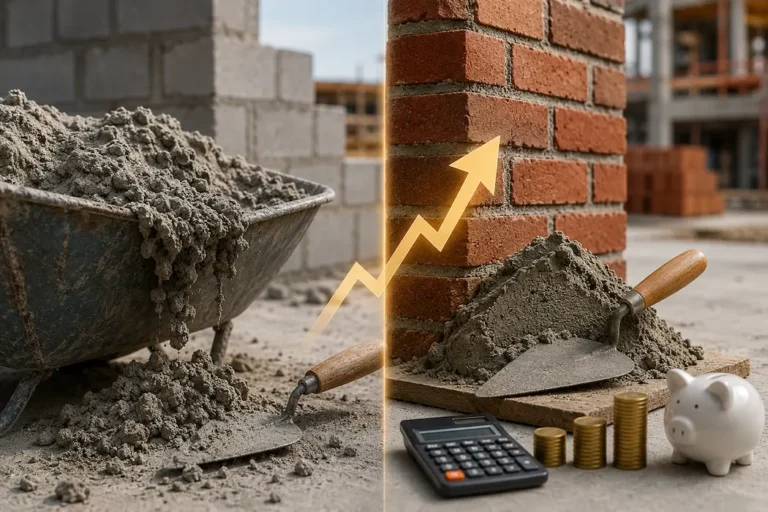


Specifying an incorrect mortar mix causes severe masonry cracking within 24 months of project completion. This streamlined guide outlines how to match ASTM mortar types to structural needs, enforce delivery quality control, and optimize supplier contracts without compromising engineering safety.
1. Market Outlook & Key Takeaways
- Type Matching: ASTM C270 types (N, S, O, M, K) are not interchangeable; spec errors cut wall lifespans by over 30%.
- Compliance Baseline: Enforce strict ASTM C270 proportion/property specifications. Reject uncertified bulk mixes.
- Ready-Mix ROI: Preblended dry-mix carries a 15–25% material premium but reduces project risk by 40% via lower waste and error rates.
- 2026 Pricing: Expect $8–$20 per 60–80 lb bag, heavily dictated by regional freight variations ($\pm$15–30%).
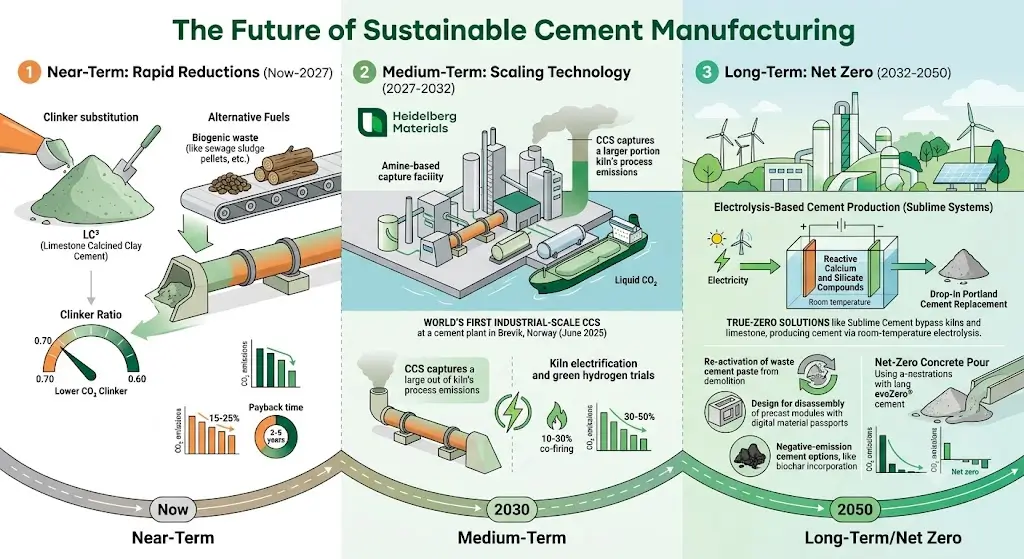
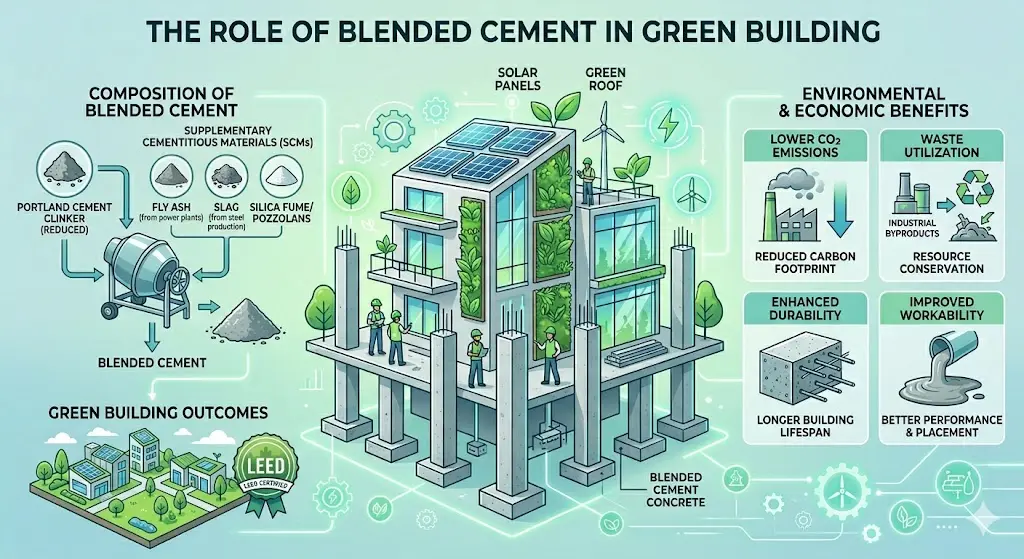
- Green Alternatives: Alkali-activated and fly-ash mixes cut carbon footprints by 30–45% while matching standard structural strengths.
2. Material Definitions: Cement vs. Mortar vs. Concrete
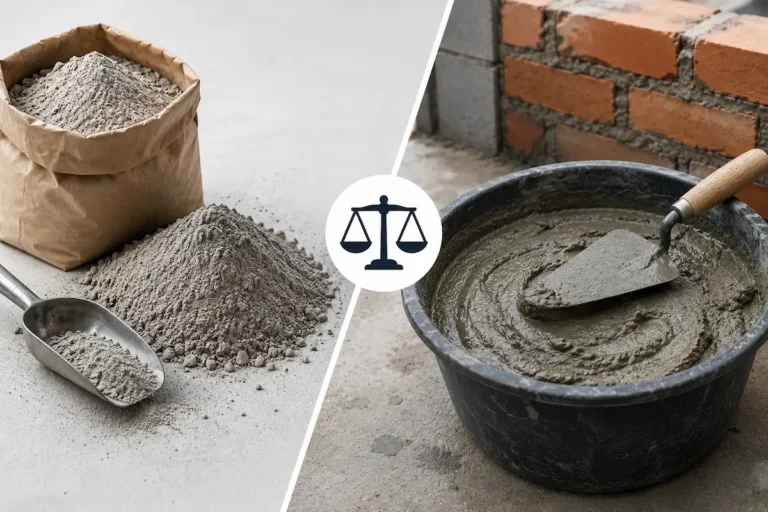
Ordering raw cement instead of pre-blended masonry mortar causes massive on-site labor overruns. Cement is a raw ingredient; mortar is the flexible cushion between blocks; concrete is the rigid structural skeleton.
| Material | Primary Ingredients | Structural Role | Compressive Strength | Chensheng Solutions |
| Cement | Portland clinker + gypsum | Raw binding agent (fine powder) | N/A (Ingredient only) | Premium Portland Cement |
| Mortar | Cement + sand + water (+ lime) | Bonds masonry; cushions joints | 350 – 2,500 psi | M5-M20 Dry-Mix Series |
| Concrete | Cement + sand + gravel + water | Structural foundations, slabs, columns | 3,000 – 5,000+ psi | Structural Ready-Mix |
3. ASTM C270 Mortar Profiles
Select mortar based on structural loading, lateral wind pressures, and freeze-thaw exposure.
- Type M (2,500 psi | 1 : ¼ : 3 ratio): High-strength for below-grade load-bearing foundations and retaining walls. Highly rigid; vulnerable to cracking under lateral shear stress. Price: $14–$20 per bag.
- Type S (1,800 psi | 1 : ½ : 4½ ratio): Structural default for load-bearing walls, seismic zones, and high-wind exterior veneers. Price: $11–$17 per bag.
- Type N (750 psi | 1 : 1 : 6 ratio): General-purpose default for above-grade exterior facades, standard brick veneers, and parapets. Price: $8–$14 per bag.
- Type O (350 psi | 1 : 2 : 9 ratio): Low-strength, high-flexibility mix for interior non-load-bearing partitions and historic restoration. Prohibited in exposed exterior zones. Price: $7–$12 per bag.
- Type K (75 psi | 1 : 3 : 12 ratio): Ultra-low strength, hyper-flexible mix reserved strictly for delicate historic monument preservation. Price: $6–$10 per bag.
The High-Strength Fallacy
Mortar must be structurally weaker than the masonry units it bonds. Overly rigid joints (e.g., Type M used on soft brick) cannot absorb natural thermal or settling movements, transferring stress directly to the masonry face and causing catastrophic surface spalling. Chensheng’s M5-M20 and ALC lines feature optimized cellulose ether water-retention packages to ensure the joint safely absorbs deformation stress.
4. 5-Step Procurement Framework
Step 1: Verify Engineering Specs
Confirm structural blueprints. Mandates like “Type S per ASTM C270” are legally binding. For complex wall systems, leverage Chensheng’s technical team for optimized brick-and-batch matching layout plans.
Step 2: Choose Your Logistics
- Factory Ready-Mix: Best for tight urban sites and high-liability builds. Batching precision is locked within $\pm$2%.
- Field Site-Mixing: Economical for massive infrastructure volumes, but introduces manual batching variances of $\pm$10–15%.
Step 3: Quantify Volume and Waste
Calculate baseline bulk demand using standard yield values:
$$\text{Bags Required} = \frac{\text{Total Joint Volume }(\text{ft}^3)}{0.48 \text{ (Average Yield per 80 lb Pre-Blended Bag)}}$$
Add a 10–15% waste factor for ready-mix, or 20–25% for site-mixing (to cover sand spillage and floor scrap). Cross-reference volumes against local masonry labor rates ($35–$90/hour).
Step 4: Enforce Technical Submittals
Prior to ordering, mandate certified documentation proving ASTM C270 compliance, 28-day lab cylinder break tests, and ASTM C144 aggregate gradation curves.
Step 5: Conduct Supplier Matrix Evaluations
Rate vendors (score 1–5) based on certification compliance, clean pricing transparency (no hidden fuel surcharges), localized safety stock availability, and dedicated engineering field support.
5. Site Quality Control Checklist
- Audit Batch Coding: Track pallet manufacturing stamps to ensure material consistency and prevent wall color shading variations.
- Eliminate Shovel Counting: Prohibit loose volumetric guesswork during site-mixing; mandate calibrated volumetric boxes.
- Implement ASTM C780 Testing: Regularly test wet mortar on site for consistency, board-life water retention, and field cylinder breaks.
- Maintain Archive Records: File all manufacturing tags, MSDS sheets, and test breaks to isolate material quality from installation liability.
6. Sustainable Low-Carbon Alternatives
Alkali-Activated Mortars (AIMs) are shifting 2026 procurement baselines. By replacing Portland cement with industrial byproducts like Class F fly ash and slag (GGBFS) reacted with an alkaline activator, these mixes achieve structural compressive strengths up to 43.75 MPa (~6,350 psi) while reducing carbon emissions by 30–45%. For projects requiring green building points (LEED/BREEAM), specify EPD-certified alternative lines to guarantee compliance without sacrificing mechanical performance.